Partial Derivatives — Question 4

PDF ↗

Question 4

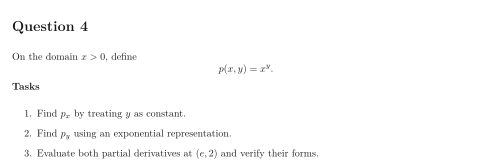
On the domain x>0x>0, define p(x,y)=xy.p(x,y)=x^y. Tasks

  1. Find pxp_x by treating yy as constant.

  2. Find pyp_y using an exponential representation.

  3. Evaluate both partial derivatives at (e,2)(e,2) and verify their forms.

Original worksheet page 1: question and worked solution for 2-2-004
Show solutionHide solution

Question 4 – Solution

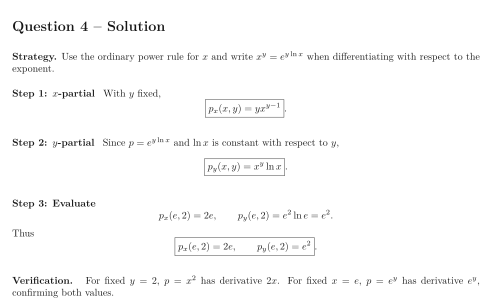
Strategy. Use the ordinary power rule for xx and write xy=eyln⁡xx^y=e^{y\ln x} when differentiating with respect to the exponent.

Step 1: xx-partial With yy fixed, px(x,y)=yxy−1.\boxed{p_x(x,y)=yx^{y-1}}.

Step 2: yy-partial Since p=eyln⁡xp=e^{y\ln x} and ln⁡x\ln x is constant with respect to yy, py(x,y)=xyln⁡x.\boxed{p_y(x,y)=x^y\ln x}.

Step 3: Evaluate px(e,2)=2e,py(e,2)=e2ln⁡e=e2.p_x(e,2)=2e,\qquad p_y(e,2)=e^2\ln e=e^2. Thus px(e,2)=2e,py(e,2)=e2.\boxed{p_x(e,2)=2e,\qquad p_y(e,2)=e^2}.

Verification. For fixed y=2y=2, p=x2p=x^2 has derivative 2x2x. For fixed x=ex=e, p=eyp=e^y has derivative eye^y, confirming both values.

Original worksheet page 2: question and worked solution for 2-2-004

Original worksheet layout. Use Enlarge or open the PDF for a closer view.