Higher Order Partial Derivatives — Question 3

PDF ↗

Question 3

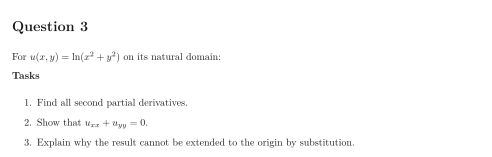
For u(x,y)=ln⁡(x2+y2)u(x,y)=\ln(x^2+y^2) on its natural domain:

Tasks

  1. Find all second partial derivatives.

  2. Show that uxx+uyy=0u_{xx}+u_{yy}=0.

  3. Explain why the result cannot be extended to the origin by substitution.
Original worksheet page 1: question and worked solution for 2-4-003
Show solutionHide solution

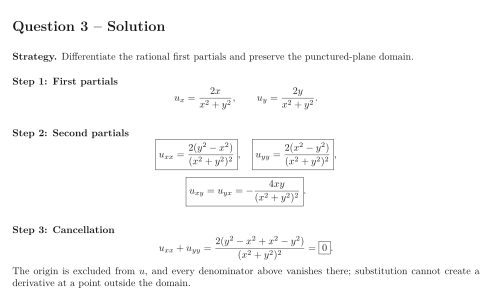
Question 3 – Solution

Strategy. Differentiate the rational first partials and preserve the punctured-plane domain.

Step 1: First partials ux=2xx2+y2,uy=2yx2+y2.u_x=\frac{2x}{x^2+y^2},\qquad u_y=\frac{2y}{x^2+y^2}.

Step 2: Second partials uxx=2(y2−x2)(x2+y2)2,uyy=2(x2−y2)(x2+y2)2,\boxed{u_{xx}=\frac{2(y^2-x^2)}{(x^2+y^2)^2}},\quad \boxed{u_{yy}=\frac{2(x^2-y^2)}{(x^2+y^2)^2}}, uxy=uyx=−4xy(x2+y2)2.\boxed{u_{xy}=u_{yx}=-\frac{4xy}{(x^2+y^2)^2}}.

Step 3: Cancellation uxx+uyy=2(y2−x2+x2−y2)(x2+y2)2=0.u_{xx}+u_{yy}=\frac{2(y^2-x^2+x^2-y^2)}{(x^2+y^2)^2}=\boxed 0. The origin is excluded from uu, and every denominator above vanishes there; substitution cannot create a derivative at a point outside the domain.
Original worksheet page 2: question and worked solution for 2-4-003

Original worksheet layout. Use Enlarge or open the PDF for a closer view.