Differentials — Question 1

PDF ↗

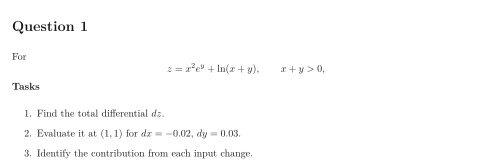
Question 1

For z=x2ey+ln⁡(x+y),x+y>0,z=x^2e^y+\ln(x+y),\qquad x+y>0, Tasks

  1. Find the total differential dzdz.

  2. Evaluate it at (1,1)(1,1) for dx=−0.02dx=-0.02, dy=0.03dy=0.03.

  3. Identify the contribution from each input change.
Original worksheet page 1: question and worked solution for 2-5-001
Show solutionHide solution

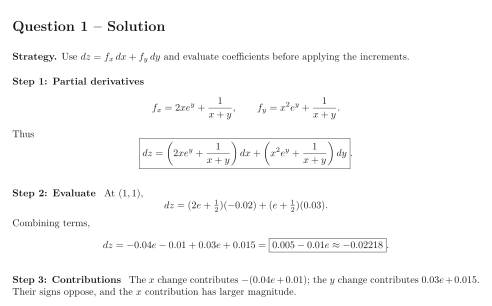
Question 1 – Solution

Strategy. Use dz=fxdx+fydydz=f_x\,dx+f_y\,dy and evaluate coefficients before applying the increments.

Step 1: Partial derivatives fx=2xey+1x+y,fy=x2ey+1x+y.f_x=2xe^y+\frac 1{x+y},\qquad f_y=x^2e^y+\frac 1{x+y}. Thus dz=(2xey+1x+y)dx+(x2ey+1x+y)dy.\boxed{dz=\left(2xe^y+\frac 1{x+y}\right)dx+ \left(x^2e^y+\frac 1{x+y}\right)dy}.

Step 2: Evaluate At (1,1)(1,1), dz=(2e+12)(−0.02)+(e+12)(0.03).dz=(2e+\tfrac 12)(-0.02)+(e+\tfrac 12)(0.03). Combining terms, dz=−0.04e−0.01+0.03e+0.015=0.005−0.01e≈−0.02218.dz=-0.04e-0.01+0.03e+0.015 =\boxed{0.005-0.01e\approx-0.02218}.

Step 3: Contributions The xx change contributes −(0.04e+0.01)-(0.04e+0.01); the yy change contributes 0.03e+0.0150.03e+0.015. Their signs oppose, and the xx contribution has larger magnitude.

Original worksheet page 2: question and worked solution for 2-5-001

Original worksheet layout. Use Enlarge or open the PDF for a closer view.