Differentials — Question 10

PDF ↗

Question 10

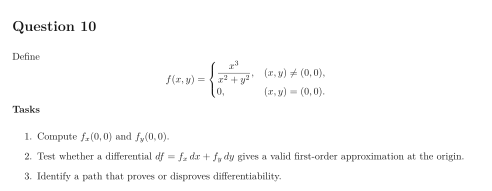
Define f(x,y)={x3x2+y2,(x,y)≠(0,0),0,(x,y)=(0,0).f(x,y)= \begin{cases} \dfrac{x^3}{x^2+y^2},&(x,y)\ne(0,0),\\ 0,&(x,y)=(0,0). \end{cases} Tasks

  1. Compute fx(0,0)f_x(0,0) and fy(0,0)f_y(0,0).

  2. Test whether a differential df=fxdx+fydydf=f_x\,dx+f_y\,dy gives a valid first-order approximation at the origin.

  3. Identify a path that proves or disproves differentiability.
Original worksheet page 1: question and worked solution for 2-5-010
Show solutionHide solution

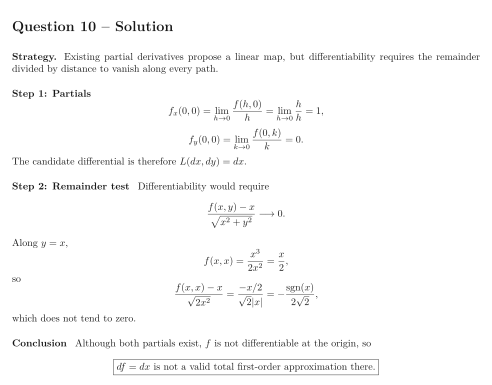
Question 10 – Solution

Strategy. Existing partial derivatives propose a linear map, but differentiability requires the remainder divided by distance to vanish along every path.

Step 1: Partials fx(0,0)=limh→0f(h,0)h=limh→0hh=1,f_x(0,0)=\lim_{h\to 0}\frac{f(h,0)}h =\lim_{h\to 0}\frac{h}{h}=1, fy(0,0)=limk→0f(0,k)k=0.f_y(0,0)=\lim_{k\to 0}\frac{f(0,k)}k=0. The candidate differential is therefore L(dx,dy)=dxL(dx,dy)=dx.

Step 2: Remainder test Differentiability would require f(x,y)−xx2+y2→0.\frac{f(x,y)-x}{\sqrt{x^2+y^2}}\longrightarrow 0. Along y=xy=x, f(x,x)=x32x2=x2,f(x,x)=\frac{x^3}{2x^2}=\frac x2, so f(x,x)−x2x2=−x/22|x|=−sgn⁡(x)22,\frac{f(x,x)-x}{\sqrt{2x^2}} =\frac{-x/2}{\sqrt 2|x|}=-\frac{\operatorname{sgn}(x)}{2\sqrt 2}, which does not tend to zero.

Conclusion Although both partials exist, ff is not differentiable at the origin, so df=dx is not a valid total first-order approximation there.\boxed{df=dx\text{ is not a valid total first-order approximation there}.}
Original worksheet page 2: question and worked solution for 2-5-010

Original worksheet layout. Use Enlarge or open the PDF for a closer view.