Chain Rule — Question 2

PDF ↗

Question 2

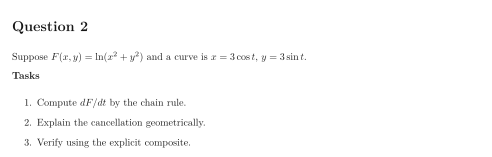
Suppose F(x,y)=ln⁡(x2+y2)F(x,y)=\ln(x^2+y^2) and a curve is x=3cos⁡tx=3\cos t, y=3sin⁡ty=3\sin t.

Tasks

  1. Compute dF/dtdF/dt by the chain rule.

  2. Explain the cancellation geometrically.

  3. Verify using the explicit composite.

Original worksheet page 1: question and worked solution for 2-6-002
Show solutionHide solution

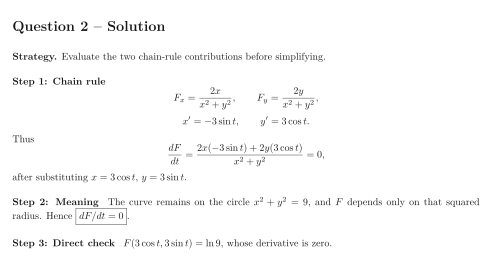
Question 2 – Solution

Strategy. Evaluate the two chain-rule contributions before simplifying.

Step 1: Chain rule Fx=2xx2+y2,Fy=2yx2+y2,F_x=\frac{2x}{x^2+y^2},\qquad F_y=\frac{2y}{x^2+y^2}, x′=−3sin⁡t,y′=3cos⁡t.x'=-3\sin t,\qquad y'=3\cos t. Thus dFdt=2x(−3sin⁡t)+2y(3cos⁡t)x2+y2=0,\frac{dF}{dt}=\frac{2x(-3\sin t)+2y(3\cos t)}{x^2+y^2}=0, after substituting x=3cos⁡tx=3\cos t, y=3sin⁡ty=3\sin t.

Step 2: Meaning The curve remains on the circle x2+y2=9x^2+y^2=9, and FF depends only on that squared radius. Hence dF/dt=0\boxed{dF/dt=0}.

Step 3: Direct check F(3cos⁡t,3sin⁡t)=ln⁡9F(3\cos t,3\sin t)=\ln 9, whose derivative is zero.

Original worksheet page 2: question and worked solution for 2-6-002

Original worksheet layout. Use Enlarge or open the PDF for a closer view.