Chain Rule — Question 4

PDF ↗

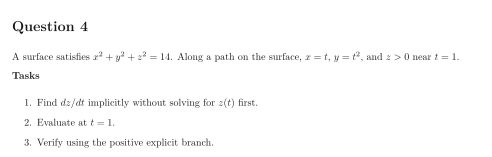
Question 4

A surface satisfies x2+y2+z2=14x^2+y^2+z^2=14. Along a path on the surface, x=tx=t, y=t2y=t^2, and z>0z>0 near t=1t=1.

Tasks

  1. Find dz/dtdz/dt implicitly without solving for z(t)z(t) first.

  2. Evaluate at t=1t=1.

  3. Verify using the positive explicit branch.
Original worksheet page 1: question and worked solution for 2-6-004
Show solutionHide solution

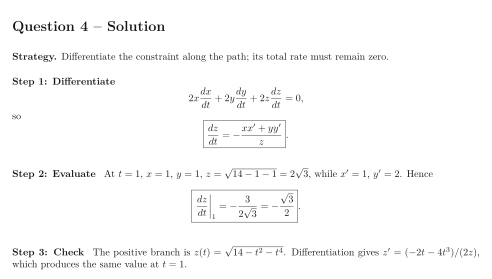
Question 4 – Solution

Strategy. Differentiate the constraint along the path; its total rate must remain zero.

Step 1: Differentiate 2xdxdt+2ydydt+2zdzdt=0,2x\frac{dx}{dt}+2y\frac{dy}{dt}+2z\frac{dz}{dt}=0, so dzdt=−xx′+yy′z.\boxed{\frac{dz}{dt}=-\frac{x x'+y y'}z}.

Step 2: Evaluate At t=1t=1, x=1x=1, y=1y=1, z=14−1−1=23z=\sqrt{14-1-1}=2\sqrt 3, while x′=1x'=1, y′=2y'=2. Hence dzdt|1=−323=−32.\boxed{\left.\frac{dz}{dt}\right|_{1}=-\frac{3}{2\sqrt 3}=-\frac{\sqrt 3}{2}}.

Step 3: Check The positive branch is z(t)=14−t2−t4z(t)=\sqrt{14-t^2-t^4}. Differentiation gives z′=(−2t−4t3)/(2z)z'=(-2t-4t^3)/(2z), which produces the same value at t=1t=1.

Original worksheet page 2: question and worked solution for 2-6-004

Original worksheet layout. Use Enlarge or open the PDF for a closer view.