Chain Rule — Question 5

PDF ↗

Question 5

Let u(x,y)u(x,y) be differentiable and set x=rcos⁡θx=r\cos\theta, y=rsin⁡θy=r\sin\theta.

Tasks

  1. Derive formulas for uru_r and uθu_\theta.

  2. Apply them to u=x2−y2u=x^2-y^2.

  3. Verify against the polar form of uu.

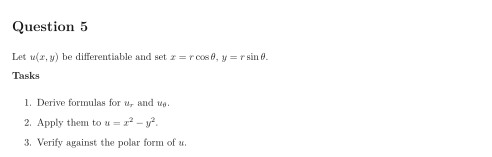
Original worksheet page 1: question and worked solution for 2-6-005
Show solutionHide solution

Question 5 – Solution

Strategy. Treat rr and θ\theta as independent inputs to the Cartesian coordinate map.

Step 1: General formulas ur=uxcos⁡θ+uysin⁡θ,\boxed{u_r=u_x\cos\theta+u_y\sin\theta}, uθ=−ruxsin⁡θ+ruycos⁡θ.\boxed{u_\theta=-r u_x\sin\theta+r u_y\cos\theta}.

Step 2: Apply For u=x2−y2u=x^2-y^2, ux=2xu_x=2x, uy=−2yu_y=-2y. Substituting x=rcos⁡θx=r\cos\theta, y=rsin⁡θy=r\sin\theta gives ur=2r(cos⁡2θ−sin⁡2θ)=2rcos⁡2θ,u_r=2r(\cos^2\theta-\sin^2\theta)=\boxed{2r\cos 2\theta}, uθ=−4r2sin⁡θcos⁡θ=−2r2sin⁡2θ.u_\theta=-4r^2\sin\theta\cos\theta=\boxed{-2r^2\sin 2\theta}.

Step 3: Verify Directly, u=r2cos⁡2θu=r^2\cos 2\theta; its two ordinary partial derivatives match both formulas.
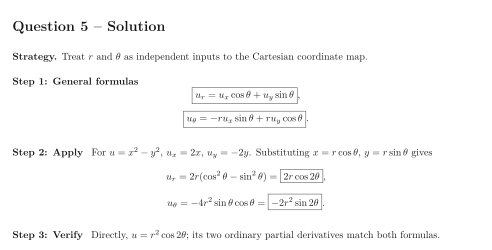
Original worksheet page 2: question and worked solution for 2-6-005

Original worksheet layout. Use Enlarge or open the PDF for a closer view.