Chain Rule — Question 8

PDF ↗

Question 8

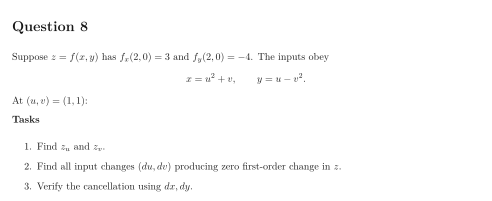
Suppose z=f(x,y)z=f(x,y) has fx(2,0)=3f_x(2,0)=3 and fy(2,0)=−4f_y(2,0)=-4. The inputs obey x=u2+v,y=u−v2.x=u^2+v,\qquad y=u-v^2. At (u,v)=(1,1)(u,v)=(1,1):

Tasks

  1. Find zuz_u and zvz_v.

  2. Find all input changes (du,dv)(du,dv) producing zero first-order change in zz.

  3. Verify the cancellation using dx,dydx,dy.

Original worksheet page 1: question and worked solution for 2-6-008
Show solutionHide solution

Question 8 – Solution

Strategy. First propagate u,vu,v changes to x,yx,y, then combine them with the supplied partials.

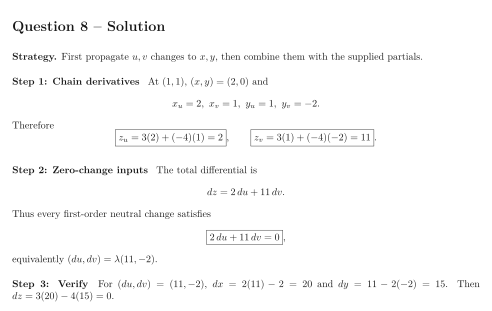
Step 1: Chain derivatives At (1,1)(1,1), (x,y)=(2,0)(x,y)=(2,0) and xu=2,xv=1,yu=1,yv=−2.x_u=2,\ x_v=1,\ y_u=1,\ y_v=-2. Therefore zu=3(2)+(−4)(1)=2,zv=3(1)+(−4)(−2)=11.\boxed{z_u=3(2)+(-4)(1)=2},\qquad \boxed{z_v=3(1)+(-4)(-2)=11}.

Step 2: Zero-change inputs The total differential is dz=2du+11dv.dz=2\,du+11\,dv. Thus every first-order neutral change satisfies 2du+11dv=0,\boxed{2\,du+11\,dv=0}, equivalently (du,dv)=λ(11,−2)(du,dv)=\lambda(11,-2).

Step 3: Verify For (du,dv)=(11,−2)(du,dv)=(11,-2), dx=2(11)−2=20dx=2(11)-2=20 and dy=11−2(−2)=15dy=11-2(-2)=15. Then dz=3(20)−4(15)=0dz=3(20)-4(15)=0.

Original worksheet page 2: question and worked solution for 2-6-008

Original worksheet layout. Use Enlarge or open the PDF for a closer view.