Chain Rule — Question 10

PDF ↗

Question 10

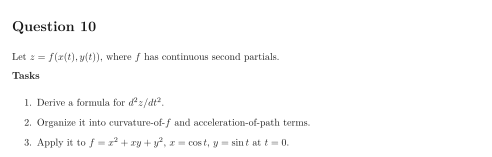
Let z=f(x(t),y(t))z=f(x(t),y(t)), where ff has continuous second partials.

Tasks

  1. Derive a formula for d2z/dt2d^2z/dt^2.

  2. Organize it into curvature-of-ff and acceleration-of-path terms.

  3. Apply it to f=x2+xy+y2f=x^2+xy+y^2, x=cos⁡tx=\cos t, y=sin⁡ty=\sin t at t=0t=0.

Original worksheet page 1: question and worked solution for 2-6-010
Show solutionHide solution

Question 10 – Solution

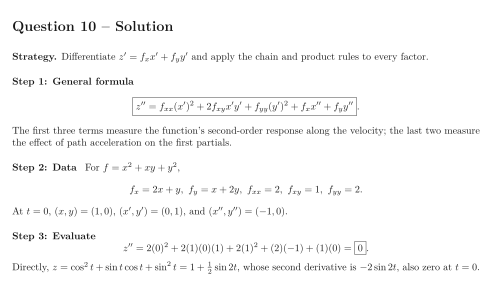
Strategy. Differentiate z′=fxx′+fyy′z'=f_xx'+f_yy' and apply the chain and product rules to every factor.

Step 1: General formula z″=fxx(x′)2+2fxyx′y′+fyy(y′)2+fxx″+fyy″.\boxed{z''=f_{xx}(x')^2+2f_{xy}x'y'+f_{yy}(y')^2+f_xx''+f_yy''}. The first three terms measure the function’s second-order response along the velocity; the last two measure the effect of path acceleration on the first partials.

Step 2: Data For f=x2+xy+y2f=x^2+xy+y^2, fx=2x+y,fy=x+2y,fxx=2,fxy=1,fyy=2.f_x=2x+y,\ f_y=x+2y,\ f_{xx}=2,\ f_{xy}=1,\ f_{yy}=2. At t=0t=0, (x,y)=(1,0)(x,y)=(1,0), (x′,y′)=(0,1)(x',y')=(0,1), and (x″,y″)=(−1,0)(x'',y'')=(-1,0).

Step 3: Evaluate z″=2(0)2+2(1)(0)(1)+2(1)2+(2)(−1)+(1)(0)=0.z''=2(0)^2+2(1)(0)(1)+2(1)^2+(2)(-1)+(1)(0)=\boxed 0. Directly, z=cos⁡2t+sin⁡tcos⁡t+sin⁡2t=1+12sin⁡2tz=\cos^2t+\sin t\cos t+\sin^2t=1+\tfrac 12\sin 2t, whose second derivative is −2sin⁡2t-2\sin 2t, also zero at t=0t=0.

Original worksheet page 2: question and worked solution for 2-6-010

Original worksheet layout. Use Enlarge or open the PDF for a closer view.