Directional Derivatives — Question 2

PDF ↗

Question 2

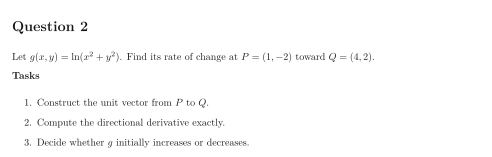
Let g(x,y)=ln⁡(x2+y2)g(x,y)=\ln(x^2+y^2). Find its rate of change at P=(1,−2)P=(1,-2) toward Q=(4,2)Q=(4,2).

Tasks

  1. Construct the unit vector from PP to QQ.

  2. Compute the directional derivative exactly.

  3. Decide whether gg initially increases or decreases.

Original worksheet page 1: question and worked solution for 2-7-002
Show solutionHide solution

Question 2 – Solution

Strategy. Subtract endpoint coordinates in the correct order before normalizing.

Step 1: Direction PQ→=⟨3,4⟩,u=⟨3/5,4/5⟩.\overrightarrow{PQ}=\left\langle 3,4\right\rangle,\qquad u=\left\langle 3/5,4/5\right\rangle.

Step 2: Gradient ∇g=⟨2xx2+y2,2yx2+y2⟩,\nabla g=\left\langle\frac{2x}{x^2+y^2},\frac{2y}{x^2+y^2}\right\rangle, so ∇g(1,−2)=⟨2/5,−4/5⟩.\nabla g(1,-2)=\left\langle 2/5,-4/5\right\rangle. Therefore Dug(P)=2535−4545=−25.D_{u}g(P)=\frac 25\frac 35-\frac 45\frac 45 =\boxed{-\frac 25}.

Step 3: Interpret The negative sign means gg decreases initially toward QQ. This is consistent with the initial motion having a component toward smaller distance from the origin.
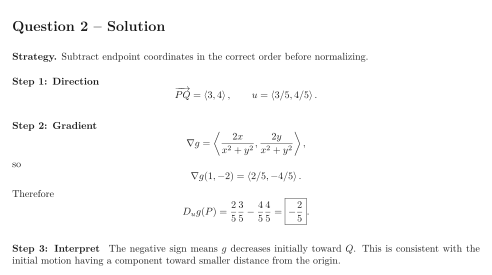
Original worksheet page 2: question and worked solution for 2-7-002

Original worksheet layout. Use Enlarge or open the PDF for a closer view.