Directional Derivatives — Question 4

PDF ↗

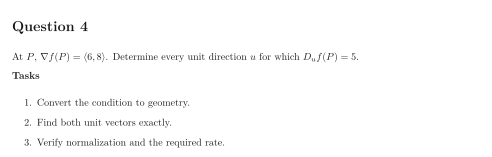
Question 4

At PP, ∇f(P)=⟨6,8⟩\nabla f(P)=\left\langle 6,8\right\rangle. Determine every unit direction uu for which Duf(P)=5D_{u}f(P)=5.

Tasks

  1. Convert the condition to geometry.

  2. Find both unit vectors exactly.

  3. Verify normalization and the required rate.
Original worksheet page 1: question and worked solution for 2-7-004
Show solutionHide solution

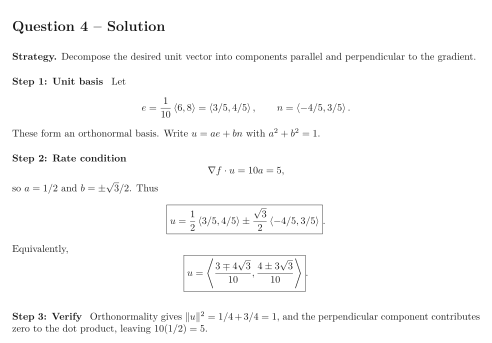
Question 4 – Solution

Strategy. Decompose the desired unit vector into components parallel and perpendicular to the gradient.

Step 1: Unit basis Let e=110⟨6,8⟩=⟨3/5,4/5⟩,n=⟨−4/5,3/5⟩.e=\frac 1{10}\left\langle 6,8\right\rangle=\left\langle 3/5,4/5\right\rangle,\qquad n=\left\langle-4/5,3/5\right\rangle. These form an orthonormal basis. Write u=ae+bnu=ae+bn with a2+b2=1a^2+b^2=1.

Step 2: Rate condition ∇f⋅u=10a=5,\nabla f\cdot u=10a=5, so a=1/2a=1/2 and b=±3/2b=\pm\sqrt 3/2. Thus u=12⟨3/5,4/5⟩±32⟨−4/5,3/5⟩.\boxed{u=\frac 12\left\langle 3/5,4/5\right\rangle\pm\frac{\sqrt 3}{2}\left\langle-4/5,3/5\right\rangle}. Equivalently, u=⟨3∓4310,4±3310⟩.\boxed{u=\left\langle\frac{3\mp 4\sqrt 3}{10},\frac{4\pm 3\sqrt 3}{10}\right\rangle}.

Step 3: Verify Orthonormality gives ∥u∥2=1/4+3/4=1\|u\|^2=1/4+3/4=1, and the perpendicular component contributes zero to the dot product, leaving 10(1/2)=510(1/2)=5.

Original worksheet page 2: question and worked solution for 2-7-004

Original worksheet layout. Use Enlarge or open the PDF for a closer view.