Directional Derivatives — Question 6

PDF ↗

Question 6

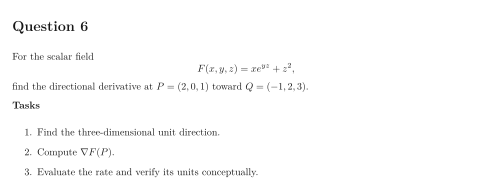
For the scalar field F(x,y,z)=xeyz+z2,F(x,y,z)=xe^{yz}+z^2, find the directional derivative at P=(2,0,1)P=(2,0,1) toward Q=(−1,2,3)Q=(-1,2,3).

Tasks

  1. Find the three-dimensional unit direction.

  2. Compute ∇F(P)\nabla F(P).

  3. Evaluate the rate and verify its units conceptually.
Original worksheet page 1: question and worked solution for 2-7-006
Show solutionHide solution

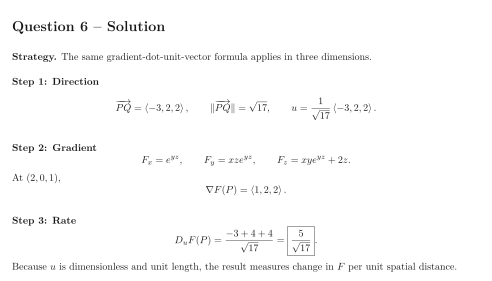
Question 6 – Solution

Strategy. The same gradient-dot-unit-vector formula applies in three dimensions.

Step 1: Direction PQ→=⟨−3,2,2⟩,∥PQ→∥=17,u=117⟨−3,2,2⟩.\overrightarrow{PQ}=\left\langle-3,2,2\right\rangle,\qquad \|\overrightarrow{PQ}\|=\sqrt{17},\qquad u=\frac 1{\sqrt{17}}\left\langle-3,2,2\right\rangle.

Step 2: Gradient Fx=eyz,Fy=xzeyz,Fz=xyeyz+2z.F_x=e^{yz},\qquad F_y=xze^{yz},\qquad F_z=xye^{yz}+2z. At (2,0,1)(2,0,1), ∇F(P)=⟨1,2,2⟩.\nabla F(P)=\left\langle 1,2,2\right\rangle.

Step 3: Rate DuF(P)=−3+4+417=517.D_{u}F(P)=\frac{-3+4+4}{\sqrt{17}} =\boxed{\frac 5{\sqrt{17}}}. Because uu is dimensionless and unit length, the result measures change in FF per unit spatial distance.

Original worksheet page 2: question and worked solution for 2-7-006

Original worksheet layout. Use Enlarge or open the PDF for a closer view.