Directional Derivatives — Question 8

PDF ↗

Question 8

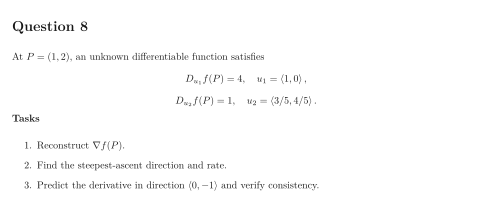
At P=(1,2)P=(1,2), an unknown differentiable function satisfies Du1f(P)=4,u1=⟨1,0⟩,D_{u_1}f(P)=4,\quad u_1=\left\langle 1,0\right\rangle, Du2f(P)=1,u2=⟨3/5,4/5⟩.D_{u_2}f(P)=1,\quad u_2=\left\langle 3/5,4/5\right\rangle. Tasks

  1. Reconstruct ∇f(P)\nabla f(P).

  2. Find the steepest-ascent direction and rate.

  3. Predict the derivative in direction ⟨0,−1⟩\left\langle 0,-1\right\rangle and verify consistency.

Original worksheet page 1: question and worked solution for 2-7-008
Show solutionHide solution

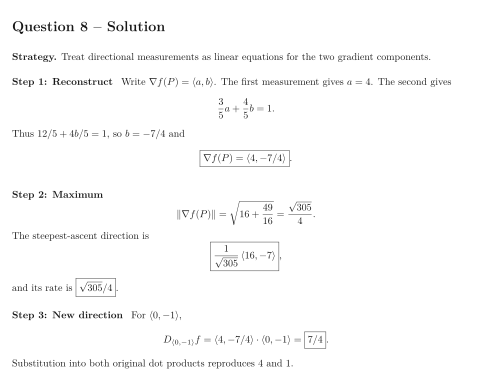
Question 8 – Solution

Strategy. Treat directional measurements as linear equations for the two gradient components.

Step 1: Reconstruct Write ∇f(P)=⟨a,b⟩\nabla f(P)=\left\langle a,b\right\rangle. The first measurement gives a=4a=4. The second gives 35a+45b=1.\frac 35a+\frac 45b=1. Thus 12/5+4b/5=112/5+4b/5=1, so b=−7/4b=-7/4 and ∇f(P)=⟨4,−7/4⟩.\boxed{\nabla f(P)=\left\langle 4,-7/4\right\rangle}.

Step 2: Maximum ∥∇f(P)∥=16+4916=3054.\|\nabla f(P)\|=\sqrt{16+\frac{49}{16}}=\frac{\sqrt{305}}4. The steepest-ascent direction is 1305⟨16,−7⟩,\boxed{\frac 1{\sqrt{305}}\left\langle 16,-7\right\rangle}, and its rate is 305/4\boxed{\sqrt{305}/4}.

Step 3: New direction For ⟨0,−1⟩\left\langle 0,-1\right\rangle, D⟨0,−1⟩f=⟨4,−7/4⟩⋅⟨0,−1⟩=7/4.D_{\left\langle 0,-1\right\rangle}f=\left\langle 4,-7/4\right\rangle\cdot\left\langle 0,-1\right\rangle=\boxed{7/4}. Substitution into both original dot products reproduces 44 and 11.

Original worksheet page 2: question and worked solution for 2-7-008

Original worksheet layout. Use Enlarge or open the PDF for a closer view.