Question 10
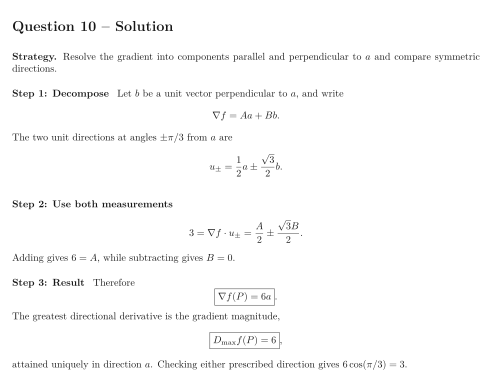
At a point , a differentiable function has unknown gradient. Its directional derivative equals in every unit direction making angle with a fixed unit vector .
Tasks
Determine what this implies about the component of along .
In two dimensions, use the two such directions to prove the perpendicular component is zero.
Determine and the maximum directional derivative.
Show solutionHide solution
Question 10 – Solution
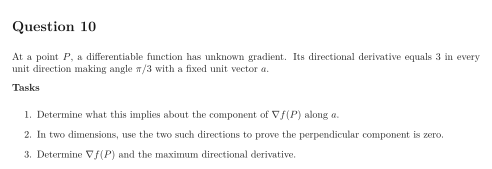
Strategy. Resolve the gradient into components parallel and perpendicular to and compare symmetric directions.
Step 1: Decompose Let be a unit vector perpendicular to , and write The two unit directions at angles from are
Step 2: Use both measurements Adding gives , while subtracting gives .
Step 3: Result Therefore The greatest directional derivative is the gradient magnitude, attained uniquely in direction . Checking either prescribed direction gives .