Tangent Planes and Linear Approximations — Question 8

PDF ↗

Question 8

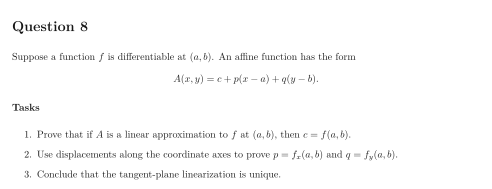
Suppose a function ff is differentiable at (a,b)(a,b). An affine function has the form A(x,y)=c+p(x−a)+q(y−b).A(x,y)=c+p(x-a)+q(y-b).

Tasks

  1. Prove that if AA is a linear approximation to ff at (a,b)(a,b), then c=f(a,b)c=f(a,b).

  2. Use displacements along the coordinate axes to prove p=fx(a,b)p=f_x(a,b) and q=fy(a,b)q=f_y(a,b).

  3. Conclude that the tangent-plane linearization is unique.
Original worksheet page 1: question and worked solution for 3-1-008
Show solutionHide solution

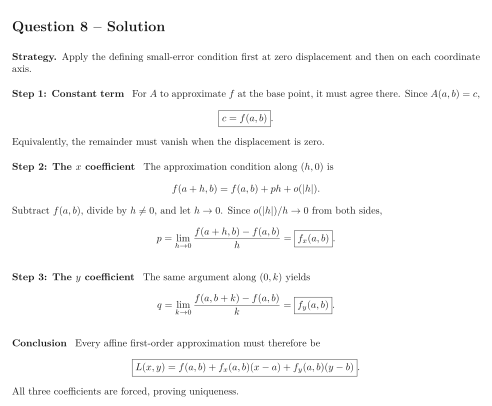
Question 8 – Solution

Strategy. Apply the defining small-error condition first at zero displacement and then on each coordinate axis.

Step 1: Constant term For AA to approximate ff at the base point, it must agree there. Since A(a,b)=cA(a,b)=c, c=f(a,b).\boxed{c=f(a,b)}. Equivalently, the remainder must vanish when the displacement is zero.

Step 2: The xx coefficient The approximation condition along (h,0)(h,0) is f(a+h,b)=f(a,b)+ph+o(|h|).f(a+h,b)=f(a,b)+ph+o(|h|). Subtract f(a,b)f(a,b), divide by h≠0h\ne 0, and let h→0h\to 0. Since o(|h|)/h→0o(|h|)/h\to 0 from both sides, p=limh→0f(a+h,b)−f(a,b)h=fx(a,b).p=\lim_{h\to 0}\frac{f(a+h,b)-f(a,b)}h =\boxed{f_x(a,b)}.

Step 3: The yy coefficient The same argument along (0,k)(0,k) yields q=limk→0f(a,b+k)−f(a,b)k=fy(a,b).q=\lim_{k\to 0}\frac{f(a,b+k)-f(a,b)}k =\boxed{f_y(a,b)}.

Conclusion Every affine first-order approximation must therefore be L(x,y)=f(a,b)+fx(a,b)(x−a)+fy(a,b)(y−b).\boxed{L(x,y)=f(a,b)+f_x(a,b)(x-a)+f_y(a,b)(y-b)}. All three coefficients are forced, proving uniqueness.
Original worksheet page 2: question and worked solution for 3-1-008

Original worksheet layout. Use Enlarge or open the PDF for a closer view.