Gradient Vector, Tangent Planes and Normal Lines — Question 2

PDF ↗

Question 2

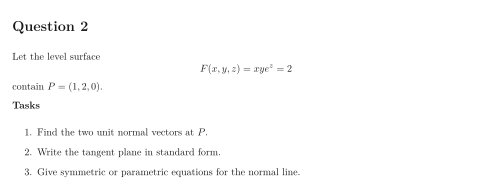
Let the level surface F(x,y,z)=xyez=2F(x,y,z)=xye^z=2 contain P=(1,2,0)P=(1,2,0).

Tasks

  1. Find the two unit normal vectors at PP.

  2. Write the tangent plane in standard form.

  3. Give symmetric or parametric equations for the normal line.
Original worksheet page 1: question and worked solution for 3-2-002
Show solutionHide solution

Question 2 – Solution

Strategy. Differentiate the defining level function; its gradient supplies both the plane normal and the normal-line direction.

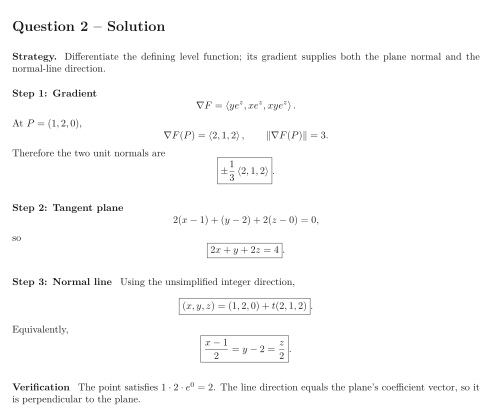
Step 1: Gradient ∇F=⟨yez,xez,xyez⟩.\nabla F=\left\langle ye^z,xe^z,xye^z\right\rangle. At P=(1,2,0)P=(1,2,0), ∇F(P)=⟨2,1,2⟩,∥∇F(P)∥=3.\nabla F(P)=\left\langle 2,1,2\right\rangle,\qquad \|\nabla F(P)\|=3. Therefore the two unit normals are ±13⟨2,1,2⟩.\boxed{\pm\frac 13\left\langle 2,1,2\right\rangle}.

Step 2: Tangent plane 2(x−1)+(y−2)+2(z−0)=0,2(x-1)+(y-2)+2(z-0)=0, so 2x+y+2z=4.\boxed{2x+y+2z=4}.

Step 3: Normal line Using the unsimplified integer direction, (x,y,z)=(1,2,0)+t(2,1,2).\boxed{(x,y,z)=(1,2,0)+t(2,1,2)}. Equivalently, x−12=y−2=z2.\boxed{\frac{x-1}{2}=y-2=\frac z2}.

Verification The point satisfies 1⋅2⋅e0=21\cdot 2\cdot e^0=2. The line direction equals the plane’s coefficient vector, so it is perpendicular to the plane.
Original worksheet page 2: question and worked solution for 3-2-002

Original worksheet layout. Use Enlarge or open the PDF for a closer view.