Gradient Vector, Tangent Planes and Normal Lines — Question 5

PDF ↗

Question 5

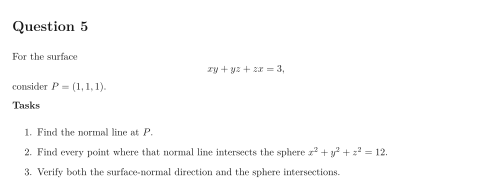
For the surface xy+yz+zx=3,xy+yz+zx=3, consider P=(1,1,1)P=(1,1,1).

Tasks

  1. Find the normal line at PP.

  2. Find every point where that normal line intersects the sphere x2+y2+z2=12x^2+y^2+z^2=12.

  3. Verify both the surface-normal direction and the sphere intersections.
Original worksheet page 1: question and worked solution for 3-2-005
Show solutionHide solution

Question 5 – Solution

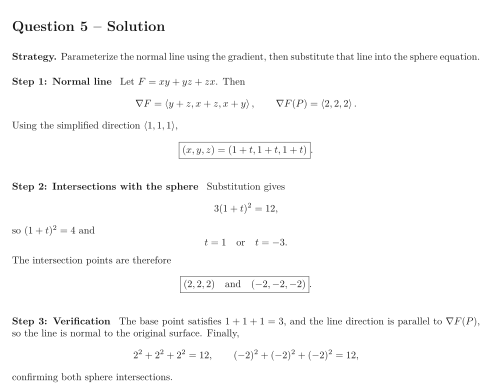
Strategy. Parameterize the normal line using the gradient, then substitute that line into the sphere equation.

Step 1: Normal line Let F=xy+yz+zxF=xy+yz+zx. Then ∇F=⟨y+z,x+z,x+y⟩,∇F(P)=⟨2,2,2⟩.\nabla F=\left\langle y+z,x+z,x+y\right\rangle, \qquad \nabla F(P)=\left\langle 2,2,2\right\rangle. Using the simplified direction ⟨1,1,1⟩\left\langle 1,1,1\right\rangle, (x,y,z)=(1+t,1+t,1+t).\boxed{(x,y,z)=(1+t,1+t,1+t)}.

Step 2: Intersections with the sphere Substitution gives 3(1+t)2=12,3(1+t)^2=12, so (1+t)2=4(1+t)^2=4 and t=1ort=−3.t=1\quad\text{or}\quad t=-3. The intersection points are therefore (2,2,2)and(−2,−2,−2).\boxed{(2,2,2)\quad\text{and}\quad(-2,-2,-2)}.

Step 3: Verification The base point satisfies 1+1+1=31+1+1=3, and the line direction is parallel to ∇F(P)\nabla F(P), so the line is normal to the original surface. Finally, 22+22+22=12,(−2)2+(−2)2+(−2)2=12,2^2+2^2+2^2=12, \qquad (-2)^2+(-2)^2+(-2)^2=12, confirming both sphere intersections.
Original worksheet page 2: question and worked solution for 3-2-005

Original worksheet layout. Use Enlarge or open the PDF for a closer view.