Gradient Vector, Tangent Planes and Normal Lines — Question 7

PDF ↗

Question 7

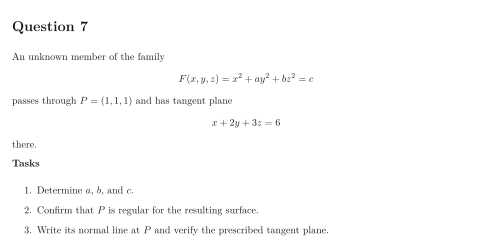
An unknown member of the family F(x,y,z)=x2+ay2+bz2=cF(x,y,z)=x^2+ay^2+bz^2=c passes through P=(1,1,1)P=(1,1,1) and has tangent plane x+2y+3z=6x+2y+3z=6 there.

Tasks

  1. Determine aa, bb, and cc.

  2. Confirm that PP is regular for the resulting surface.

  3. Write its normal line at PP and verify the prescribed tangent plane.
Original worksheet page 1: question and worked solution for 3-2-007
Show solutionHide solution

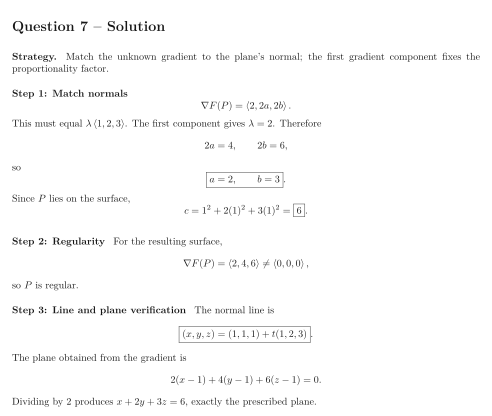
Question 7 – Solution

Strategy. Match the unknown gradient to the plane’s normal; the first gradient component fixes the proportionality factor.

Step 1: Match normals ∇F(P)=⟨2,2a,2b⟩.\nabla F(P)=\left\langle 2,2a,2b\right\rangle. This must equal λ⟨1,2,3⟩\lambda\left\langle 1,2,3\right\rangle. The first component gives λ=2\lambda=2. Therefore 2a=4,2b=6,2a=4,\qquad 2b=6, so a=2,b=3.\boxed{a=2,\qquad b=3}. Since PP lies on the surface, c=12+2(1)2+3(1)2=6.c=1^2+2(1)^2+3(1)^2=\boxed{6}.

Step 2: Regularity For the resulting surface, ∇F(P)=⟨2,4,6⟩≠⟨0,0,0⟩,\nabla F(P)=\left\langle 2,4,6\right\rangle\ne\left\langle 0,0,0\right\rangle, so PP is regular.

Step 3: Line and plane verification The normal line is (x,y,z)=(1,1,1)+t(1,2,3).\boxed{(x,y,z)=(1,1,1)+t(1,2,3)}. The plane obtained from the gradient is 2(x−1)+4(y−1)+6(z−1)=0.2(x-1)+4(y-1)+6(z-1)=0. Dividing by 22 produces x+2y+3z=6x+2y+3z=6, exactly the prescribed plane.

Original worksheet page 2: question and worked solution for 3-2-007

Original worksheet layout. Use Enlarge or open the PDF for a closer view.