Question 5
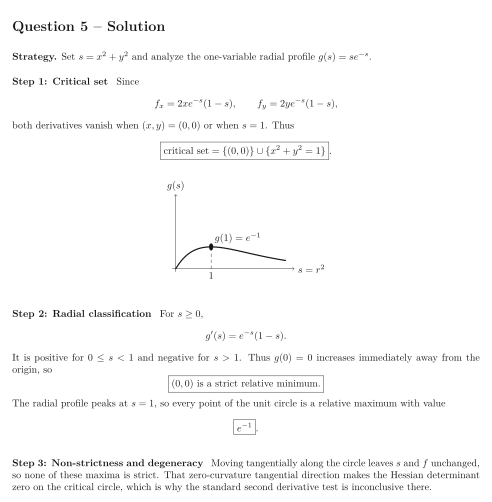
Let
Tasks
Find the complete critical set.
Classify the origin and every point on the critical circle as relative extrema.
Explain why the circular extrema are not strict and why the ordinary Hessian test degenerates there.
Show solutionHide solution
Question 5 – Solution
Strategy. Set and analyze the one-variable radial profile .
Step 1: Critical set Since both derivatives vanish when or when . Thus
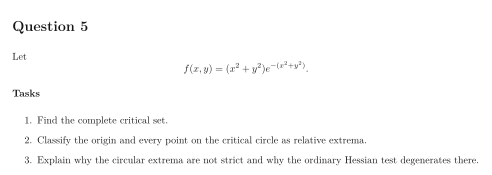
See the diagram in the original worksheet below.
Step 2: Radial classification For , It is positive for and negative for . Thus increases immediately away from the origin, so The radial profile peaks at , so every point of the unit circle is a relative maximum with value
Step 3: Non-strictness and degeneracy Moving tangentially along the circle leaves and unchanged, so none of these maxima is strict. That zero-curvature tangential direction makes the Hessian determinant zero on the critical circle, which is why the standard second derivative test is inconclusive there.