Question 7
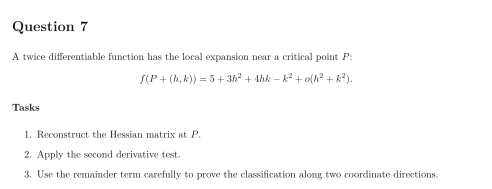
A twice differentiable function has the local expansion near a critical point :
Tasks
Reconstruct the Hessian matrix at .
Apply the second derivative test.
Use the remainder term carefully to prove the classification along two coordinate directions.
Show solutionHide solution
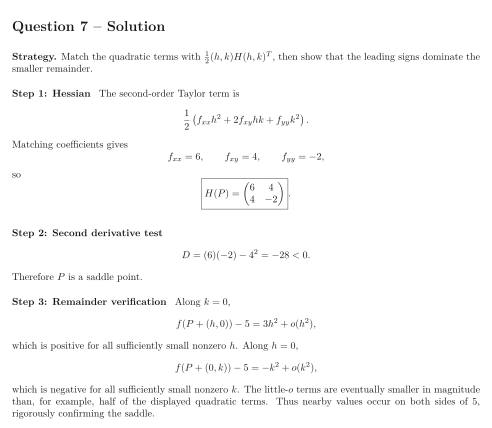
Question 7 – Solution
Strategy. Match the quadratic terms with , then show that the leading signs dominate the smaller remainder.
Step 1: Hessian The second-order Taylor term is Matching coefficients gives so
Step 2: Second derivative test Therefore is a saddle point.
Step 3: Remainder verification Along , which is positive for all sufficiently small nonzero . Along , which is negative for all sufficiently small nonzero . The little- terms are eventually smaller in magnitude than, for example, half of the displayed quadratic terms. Thus nearby values occur on both sides of , rigorously confirming the saddle.