Question 9
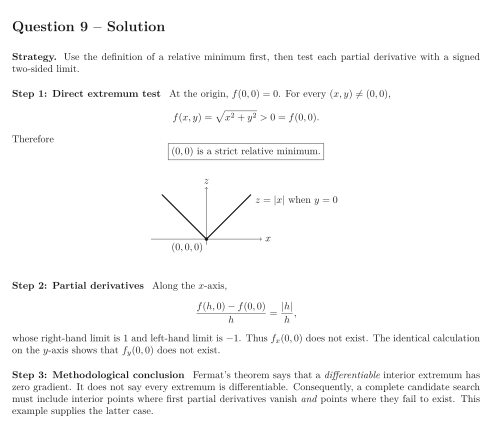
Consider
Tasks
Prove directly that the origin is a strict relative minimum.
Determine whether and exist.
Explain how this example refines the usual critical-point search procedure.
Show solutionHide solution
Question 9 – Solution
Strategy. Use the definition of a relative minimum first, then test each partial derivative with a signed two-sided limit.
Step 1: Direct extremum test At the origin, . For every , Therefore
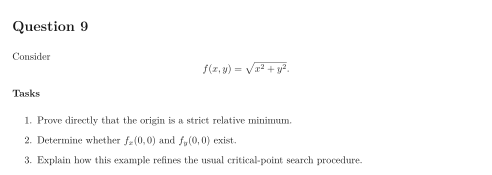
See the diagram in the original worksheet below.
Step 2: Partial derivatives Along the -axis, whose right-hand limit is and left-hand limit is . Thus does not exist. The identical calculation on the -axis shows that does not exist.
Step 3: Methodological conclusion Fermat’s theorem says that a differentiable interior extremum has zero gradient. It does not say every extremum is differentiable. Consequently, a complete candidate search must include interior points where first partial derivatives vanish and points where they fail to exist. This example supplies the latter case.