Absolute Minimums and Maximums — Question 1

PDF ↗

Question 1

Find the absolute extrema of f(x,y)=x2+y2−2x−4yf(x,y)=x^2+y^2-2x-4y on the rectangle R=[0,3]×[0,4]R=[0,3]\times[0,4].

Tasks

  1. Find all interior critical points.

  2. Analyze all four boundary segments, including their endpoints.

  3. Compare the complete candidate list and report every absolute extremum.
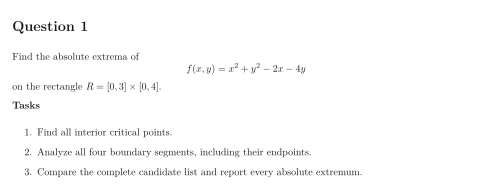
Original worksheet page 1: question and worked solution for 3-4-001
Show solutionHide solution

Question 1 – Solution

Strategy. On a closed, bounded rectangle, compare values at interior critical points, one-variable boundary critical points, and corners.

Step 1: Interior fx=2x−2,fy=2y−4.f_x=2x-2,\qquad f_y=2y-4. The sole interior critical point is (1,2)(1,2), where f(1,2)=1+4−2−8=−5.f(1,2)=1+4-2-8=\boxed{-5}.

Step 2: Boundaries On x=0x=0 and x=3x=3, f(0,y)=y2−4y,f(3,y)=y2−4y+3.f(0,y)=y^2-4y,\qquad f(3,y)=y^2-4y+3. Both have a boundary critical value at y=2y=2, giving −4-4 and −1-1. On y=0y=0 and y=4y=4, f(x,0)=f(x,4)=x2−2x,f(x,0)=f(x,4)=x^2-2x, whose critical point x=1x=1 gives −1-1. The four corner values are f(0,0)=0,f(3,0)=3,f(0,4)=0,f(3,4)=3.f(0,0)=0,\quad f(3,0)=3,\quad f(0,4)=0,\quad f(3,4)=3.

Step 3: Comparison The smallest candidate value is −5-5 and the largest is 33. Hence fmin=−5 at (1,2),\boxed{f_{\min}=-5\text{ at }(1,2)}, fmax=3 at (3,0) and (3,4).\boxed{f_{\max}=3\text{ at }(3,0)\text{ and }(3,4)}. Completing the square, f=(x−1)2+(y−2)2−5f=(x-1)^2+(y-2)^2-5, independently confirms the comparison.
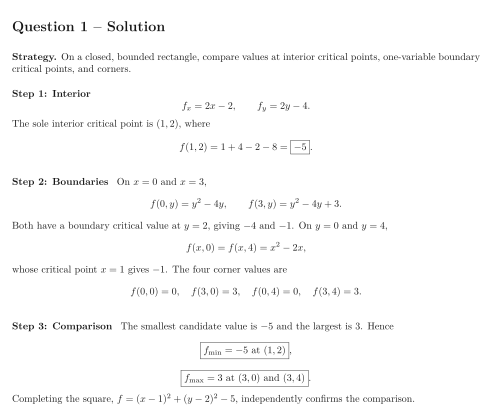
Original worksheet page 2: question and worked solution for 3-4-001

Original worksheet layout. Use Enlarge or open the PDF for a closer view.