Absolute Minimums and Maximums — Question 3

PDF ↗

Question 3

On the closed triangle T={(x,y):x≥0,y≥0,x+y≤4},T=\{(x,y):x\ge 0,\ y\ge 0,\ x+y\le 4\}, find the absolute extrema of f(x,y)=xy(4−x−y).f(x,y)=xy(4-x-y).

Tasks

  1. Find every interior critical point.

  2. Analyze all three edges and vertices.

  3. Compare the candidates and interpret why the minimum occurs along an entire boundary.
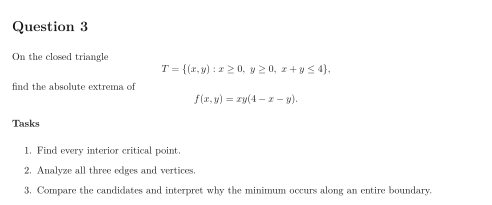
Original worksheet page 1: question and worked solution for 3-4-003
Show solutionHide solution

Question 3 – Solution

Strategy. The compact triangle guarantees extrema; compare the interior stationary value with the three edge restrictions.

Step 1: Interior fx=y(4−2x−y),fy=x(4−x−2y).f_x=y(4-2x-y),\qquad f_y=x(4-x-2y). In the interior x,y>0x,y>0, so 2x+y=4,x+2y=4.2x+y=4,\qquad x+2y=4. Thus x=y=4/3x=y=4/3, and f(43,43)=434343=6427.f\left(\frac 43,\frac 43\right) =\frac 43\frac 43\frac 43=\boxed{\frac{64}{27}}.

See the diagram in the original worksheet below.

Step 2: Boundary On x=0x=0 or y=0y=0, one factor vanishes. On x+y=4x+y=4, the third factor vanishes. Hence f=0on all three edges, including the vertices.f=0\quad\text{on all three edges, including the vertices}.

Step 3: Comparison Inside TT, all three factors xx, yy, and 4−x−y4-x-y are positive, so f>0f>0. Therefore fmin=0 at every boundary point of T,\boxed{f_{\min}=0\text{ at every boundary point of }T}, fmax=6427 at (4/3,4/3).\boxed{f_{\max}=\frac{64}{27}\text{ at }(4/3,4/3)}. The candidate list is complete because the polynomial is continuous and TT is closed and bounded.

Original worksheet page 2: question and worked solution for 3-4-003

Original worksheet layout. Use Enlarge or open the PDF for a closer view.