Question 6
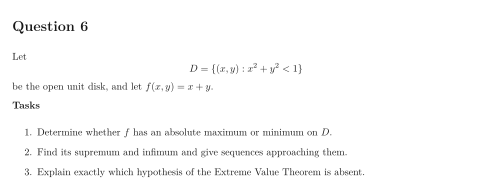
Let be the open unit disk, and let .
Tasks
Determine whether has an absolute maximum or minimum on .
Find its supremum and infimum and give sequences approaching them.
Explain exactly which hypothesis of the Extreme Value Theorem is absent.
Show solutionHide solution
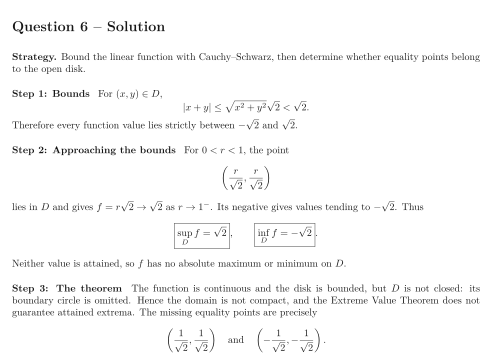
Question 6 – Solution
Strategy. Bound the linear function with Cauchy–Schwarz, then determine whether equality points belong to the open disk.
Step 1: Bounds For , Therefore every function value lies strictly between and .
Step 2: Approaching the bounds For , the point lies in and gives as . Its negative gives values tending to . Thus Neither value is attained, so has no absolute maximum or minimum on .
Step 3: The theorem The function is continuous and the disk is bounded, but is not closed: its boundary circle is omitted. Hence the domain is not compact, and the Extreme Value Theorem does not guarantee attained extrema. The missing equality points are precisely