Lagrange Multipliers — Question 1

PDF ↗

Question 1

Find the constrained extrema of f(x,y)=x+yf(x,y)=x+y subject to x2+y2=1.x^2+y^2=1.

Tasks

  1. Write and solve the Lagrange multiplier equations.

  2. Determine the maximum and minimum values and their locations.

  3. Interpret the multiplier condition as tangency of level curves.
Original worksheet page 1: question and worked solution for 3-5-001
Show solutionHide solution

Question 1 – Solution

Strategy. Solve ∇f=λ∇g\nabla f=\lambda\nabla g together with the circular constraint, then compare the finite candidate set.

Step 1: Lagrange system Let g=x2+y2g=x^2+y^2. Then ⟨1,1⟩=λ⟨2x,2y⟩,x2+y2=1.\left\langle 1,1\right\rangle=\lambda\left\langle 2x,2y\right\rangle, \qquad x^2+y^2=1. The first two equations imply x=yx=y. Hence 2x2=12x^2=1, so (x,y)=(12,12)or(−12,−12).(x,y)=\left(\frac 1{\sqrt 2},\frac 1{\sqrt 2}\right) \quad\text{or}\quad \left(-\frac 1{\sqrt 2},-\frac 1{\sqrt 2}\right).

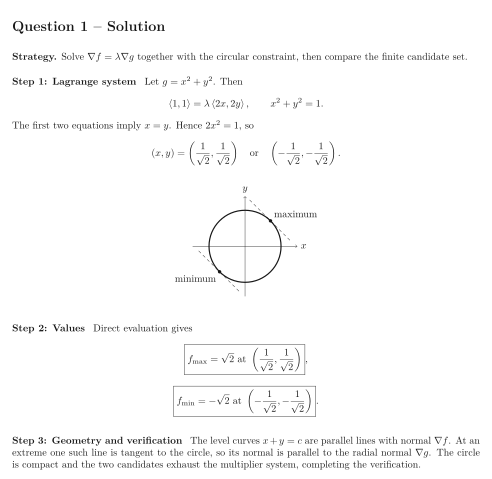
See the diagram in the original worksheet below.

Step 2: Values Direct evaluation gives fmax=2 at (12,12),\boxed{f_{\max}=\sqrt 2 \text{ at }\left(\frac 1{\sqrt 2},\frac 1{\sqrt 2}\right)}, fmin=−2 at (−12,−12).\boxed{f_{\min}=-\sqrt 2 \text{ at }\left(-\frac 1{\sqrt 2},-\frac 1{\sqrt 2}\right)}.

Step 3: Geometry and verification The level curves x+y=cx+y=c are parallel lines with normal ∇f\nabla f. At an extreme one such line is tangent to the circle, so its normal is parallel to the radial normal ∇g\nabla g. The circle is compact and the two candidates exhaust the multiplier system, completing the verification.
Original worksheet page 2: question and worked solution for 3-5-001

Original worksheet layout. Use Enlarge or open the PDF for a closer view.