Question 3
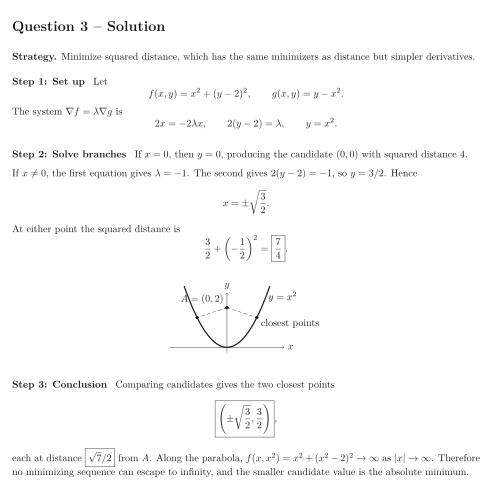
Find the points on the parabola closest to .
Tasks
Formulate the squared-distance objective and the constraint.
Solve the Lagrange system, including all branches.
Compare candidates and justify that the reported minimum is absolute despite the noncompact constraint.
Show solutionHide solution
Question 3 – Solution
Strategy. Minimize squared distance, which has the same minimizers as distance but simpler derivatives.
Step 1: Set up Let The system is
Step 2: Solve branches If , then , producing the candidate with squared distance .
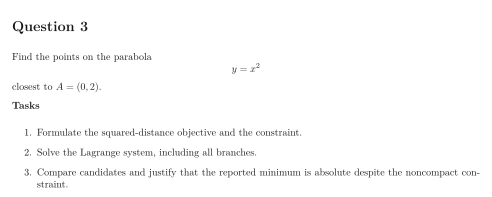
If , the first equation gives . The second gives , so . Hence At either point the squared distance is
See the diagram in the original worksheet below.
Step 3: Conclusion Comparing candidates gives the two closest points each at distance from . Along the parabola, as . Therefore no minimizing sequence can escape to infinity, and the smaller candidate value is the absolute minimum.