Question 5
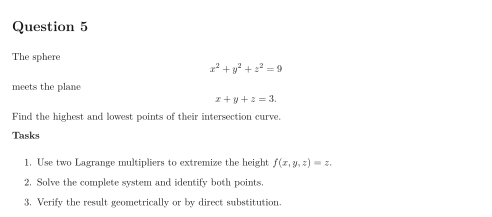
The sphere meets the plane Find the highest and lowest points of their intersection curve.
Tasks
Use two Lagrange multipliers to extremize the height .
Solve the complete system and identify both points.
Verify the result geometrically or by direct substitution.
Show solutionHide solution
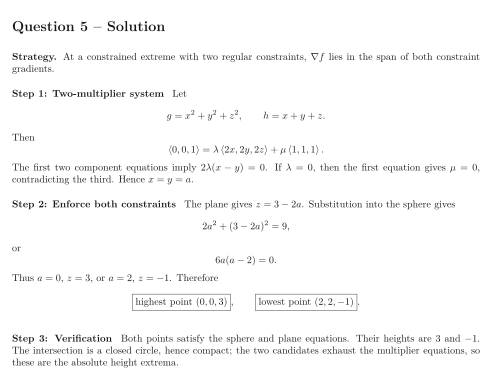
Question 5 – Solution
Strategy. At a constrained extreme with two regular constraints, lies in the span of both constraint gradients.
Step 1: Two-multiplier system Let Then The first two component equations imply . If , then the first equation gives , contradicting the third. Hence .
Step 2: Enforce both constraints The plane gives . Substitution into the sphere gives or Thus , , or , . Therefore
Step 3: Verification Both points satisfy the sphere and plane equations. Their heights are and . The intersection is a closed circle, hence compact; the two candidates exhaust the multiplier equations, so these are the absolute height extrema.