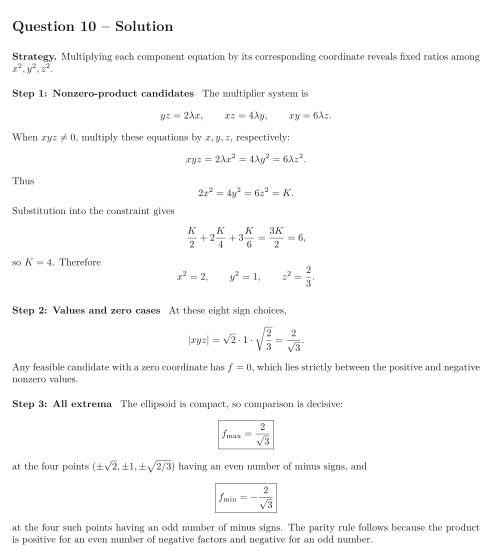
Question 10
Find the absolute extrema of on the ellipsoid
Tasks
Solve the Lagrange equations for candidates with nonzero product.
Treat zero-coordinate candidates and compare all possible values.
List every maximizing and minimizing point and verify the sign pattern.
Show solutionHide solution
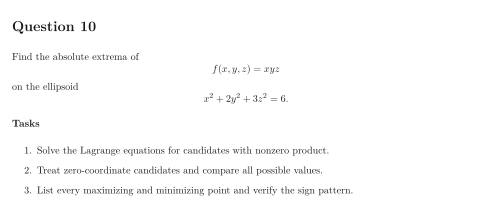
Question 10 – Solution
Strategy. Multiplying each component equation by its corresponding coordinate reveals fixed ratios among .
Step 1: Nonzero-product candidates The multiplier system is When , multiply these equations by , respectively: Thus Substitution into the constraint gives so . Therefore
Step 2: Values and zero cases At these eight sign choices, Any feasible candidate with a zero coordinate has , which lies strictly between the positive and negative nonzero values.
Step 3: All extrema The ellipsoid is compact, so comparison is decisive: at the four points having an even number of minus signs, and at the four such points having an odd number of minus signs. The parity rule follows because the product is positive for an even number of negative factors and negative for an odd number.