Double Integrals — Question 2

PDF ↗

Question 2

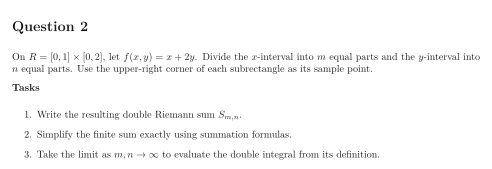
On R=[0,1]×[0,2]R=[0,1]\times[0,2], let f(x,y)=x+2yf(x,y)=x+2y. Divide the xx-interval into mm equal parts and the yy-interval into nn equal parts. Use the upper-right corner of each subrectangle as its sample point.

Tasks

  1. Write the resulting double Riemann sum Sm,nS_{m,n}.

  2. Simplify the finite sum exactly using summation formulas.

  3. Take the limit as m,n→∞m,n\to\infty to evaluate the double integral from its definition.
Original worksheet page 1: question and worked solution for 4-1-002
Show solutionHide solution

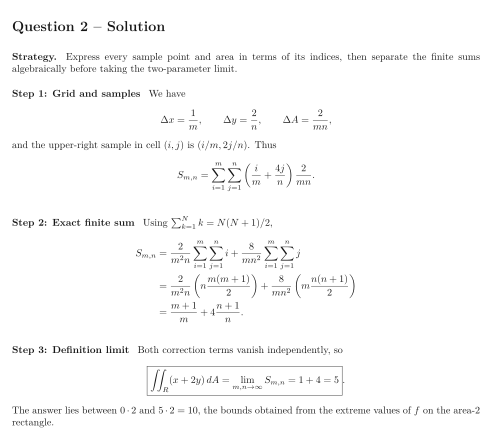
Question 2 – Solution

Strategy. Express every sample point and area in terms of its indices, then separate the finite sums algebraically before taking the two-parameter limit.

Step 1: Grid and samples We have Δx=1m,Δy=2n,ΔA=2mn,\Delta x=\frac 1m,\qquad \Delta y=\frac 2n,\qquad \Delta A=\frac{2}{mn}, and the upper-right sample in cell (i,j)(i,j) is (i/m,2j/n)(i/m,2j/n). Thus Sm,n=∑i=1m∑j=1n(im+4jn)2mn.S_{m,n}=\sum_{i=1}^{m}\sum_{j=1}^{n} \left(\frac{i}{m}+\frac{4j}{n}\right)\frac{2}{mn}.

Step 2: Exact finite sum Using ∑k=1Nk=N(N+1)/2\sum_{k=1}^{N}k=N(N+1)/2, Sm,n=2m2n∑i=1m∑j=1ni+8mn2∑i=1m∑j=1nj=2m2n(nm(m+1)2)+8mn2(mn(n+1)2)=m+1m+4n+1n.\begin{align*} S_{m,n} &=\frac{2}{m^2n}\sum_{i=1}^{m}\sum_{j=1}^{n}i +\frac{8}{mn^2}\sum_{i=1}^{m}\sum_{j=1}^{n}j\\ &=\frac{2}{m^2n}\left(n\frac{m(m+1)}2\right) +\frac{8}{mn^2}\left(m\frac{n(n+1)}2\right)\\ &=\frac{m+1}{m}+4\frac{n+1}{n}. \end{align*}

Step 3: Definition limit Both correction terms vanish independently, so ∬R(x+2y)dA=limm,n→∞Sm,n=1+4=5.\boxed{\iint_R(x+2y)\,dA=\lim_{m,n\to\infty}S_{m,n}=1+4=5}. The answer lies between 0⋅20\cdot 2 and 5⋅2=105\cdot 2=10, the bounds obtained from the extreme values of ff on the area-22 rectangle.

Original worksheet page 2: question and worked solution for 4-1-002

Original worksheet layout. Use Enlarge or open the PDF for a closer view.