Question 7
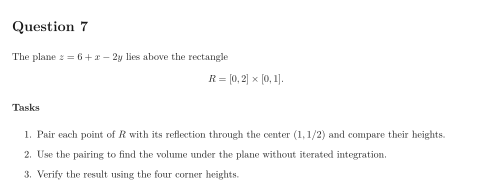
The plane lies above the rectangle
Tasks
Pair each point of with its reflection through the center and compare their heights.
Use the pairing to find the volume under the plane without iterated integration.
Verify the result using the four corner heights.
Show solutionHide solution
Question 7 – Solution
Strategy. An affine function has complementary values at points reflected through a rectangle’s center, so every reflected pair has the same average height.
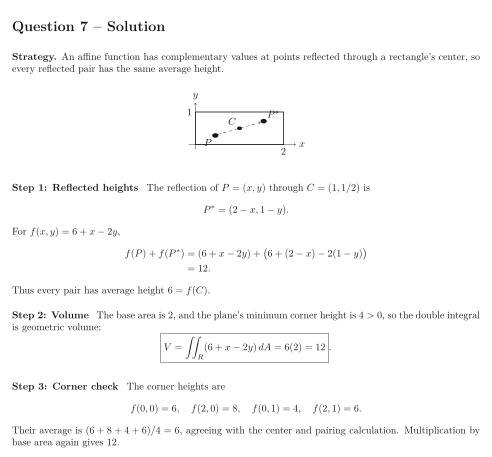
See the diagram in the original worksheet below.
Step 1: Reflected heights The reflection of through is For , Thus every pair has average height .
Step 2: Volume The base area is , and the plane’s minimum corner height is , so the double integral is geometric volume:
Step 3: Corner check The corner heights are Their average is , agreeing with the center and pairing calculation. Multiplication by base area again gives .