Question 9
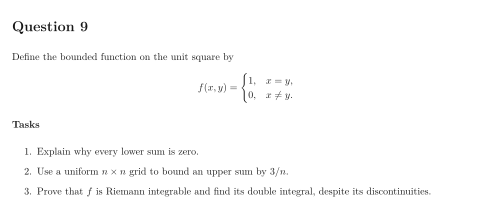
Define the bounded function on the unit square by
Tasks
Explain why every lower sum is zero.
Use a uniform grid to bound an upper sum by .
Prove that is Riemann integrable and find its double integral, despite its discontinuities.
Show solutionHide solution
Question 9 – Solution
Strategy. The diagonal has no area: trap every possible nonzero upper-sum contribution in a shrinking collection of grid squares.
See the diagram in the original worksheet below.
Step 1: Lower sums Every subrectangle with positive area contains a point off the diagonal, where . Its infimum is therefore , so every lower sum equals .
Step 2: Upper-sum cover In an grid, each square has area . The diagonal squares meet . At each of the interior diagonal grid vertices, two additional off-diagonal squares have closures meeting the diagonal. Thus at most closed grid squares have supremum ; all others have supremum . Consequently,
Step 3: Integrability Given , choose . Then The Darboux criterion proves integrability, and the integral is squeezed between zero lower sums and upper sums tending to zero: The function is discontinuous at every point of the diagonal, but that one-dimensional set contributes no area.
