Area and Volume Revisited — Question 2

PDF ↗

Question 2

Find the area common to the disks x2+y2≤2x,x2+y2≤2y.x^2+y^2\le 2x, \qquad x^2+y^2\le 2y.

Tasks

  1. Translate both inequalities into polar coordinates.

  2. Identify where the radial boundary changes and evaluate the area.

  3. Verify the symmetry used in the calculation.
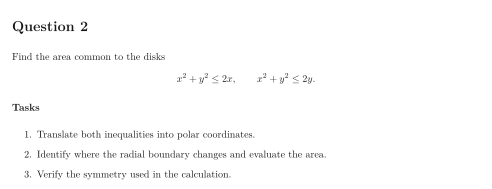
Original worksheet page 1: question and worked solution for 4-10-002
Show solutionHide solution

Question 2 – Solution

Strategy. In the first quadrant the smaller of the two polar bounds switches at the line θ=π/4\theta=\pi/4.

Step 1: Polar description

See the diagram in the original worksheet below.

For r≥0r\ge 0, the disks become r≤2cos⁡θ,r≤2sin⁡θ.r\le 2\cos\theta,\qquad r\le 2\sin\theta. Their common region lies in 0≤θ≤π/20\le\theta\le\pi/2. The bounds are equal at θ=π/4\theta=\pi/4.

Step 2: Evaluate Reflection across y=xy=x makes the two halves congruent, so A=2∫0π/4∫02sin⁡θrdrdθ=4∫0π/4sin⁡2θdθ=4[θ2−sin⁡2θ4]0π/4=π2−1.\begin{align*} A&=2\int_0^{\pi/4}\int_0^{2\sin\theta}r\,dr\,d\theta =4\int_0^{\pi/4}\sin^2\theta\,d\theta\\ &=4\left[\frac{\theta}{2}-\frac{\sin 2\theta}{4}\right]_0^{\pi/4} =\boxed{\frac{\pi}{2}-1}. \end{align*}

Verification The circles have equal radius and centers (1,0)(1,0) and (0,1)(0,1), which are interchanged by reflecting across y=xy=x. Their intersections, (0,0)(0,0) and (1,1)(1,1), also lie on that line.

Original worksheet page 2: question and worked solution for 4-10-002

Original worksheet layout. Use Enlarge or open the PDF for a closer view.