Question 7
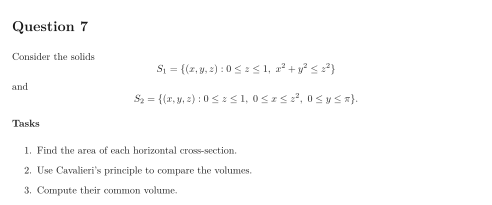
Consider the solids and
Tasks
Find the area of each horizontal cross-section.
Use Cavalieri’s principle to compare the volumes.
Compute their common volume.
Show solutionHide solution
Question 7 – Solution
Strategy. Although the slices have different shapes, compare their areas at the same height.
Step 1: Slice areas
See the diagram in the original worksheet below.
At height , the slice of is a disk of radius , so The slice of is a rectangle of side lengths and , so
Step 2: Compare and integrate Both solids occupy and have equal cross-sectional area at every height. Cavalieri’s principle therefore gives equal volumes, and
Verification The conclusion depends on slice areas, not slice shapes: circular slices in and rectangular slices in accumulate the same volume height by height.
