Iterated Integrals — Question 8

PDF ↗

Question 8

Let pp be continuous on [a,b][a,b] and qq continuous on [c,d][c,d].

Tasks

  1. Prove using iterated integrals that ∬[a,b]×[c,d]p(x)q(y)dA=(∫abp(x)dx)(∫cdq(y)dy).\iint_{[a,b]\times[c,d]}p(x)q(y)\,dA =\left(\int_a^b p(x)\,dx\right)\left(\int_c^d q(y)\,dy\right).

  2. Explain why the same proof works in either order.

  3. Apply the result to (1+x2)cos⁡y(1+x^2)\cos y on [−1,1]×[−π/2,π/2][-1,1]\times[-\pi/2,\pi/2].

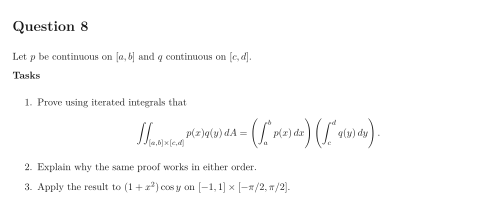
Original worksheet page 1: question and worked solution for 4-2-008
Show solutionHide solution

Question 8 – Solution

Strategy. In the inner integral, the factor depending only on the outer variable is constant and can be pulled outside.

Step 1: Factorization proof Integrating in yy first gives ∫ab∫cdp(x)q(y)dydx=∫abp(x)(∫cdq(y)dy)dx=(∫abp(x)dx)(∫cdq(y)dy).\begin{align*} \int_a^b\int_c^d p(x)q(y)\,dy\,dx &=\int_a^b p(x)\left(\int_c^d q(y)\,dy\right)dx\\ &=\left(\int_a^b p(x)\,dx\right) \left(\int_c^d q(y)\,dy\right). \end{align*} The bracketed qq-integral is a number, so it is constant in the outer xx-integration.

Step 2: Other order Reversing the order first produces the constant ∫abp(x)dx\int_a^b p(x)\,dx and then the qq-integral. Continuity on the closed rectangle guarantees Fubini’s theorem applies, so both forms represent the same double integral.

Step 3: Application Here ∫−11(1+x2)dx=[x+x33]−11=83\int_{-1}^{1}(1+x^2)\,dx =\left[x+\frac{x^3}{3}\right]_{-1}^{1}=\frac 83 and ∫−π/2π/2cos⁡ydy=[sin⁡y]−π/2π/2=2.\int_{-\pi/2}^{\pi/2}\cos y\,dy=[\sin y]_{-\pi/2}^{\pi/2}=2. Therefore ∬R(1+x2)cos⁡ydA=163.\boxed{\iint_R(1+x^2)\cos y\,dA=\frac{16}{3}}. Both factors are nonnegative on their intervals, verifying the sign.
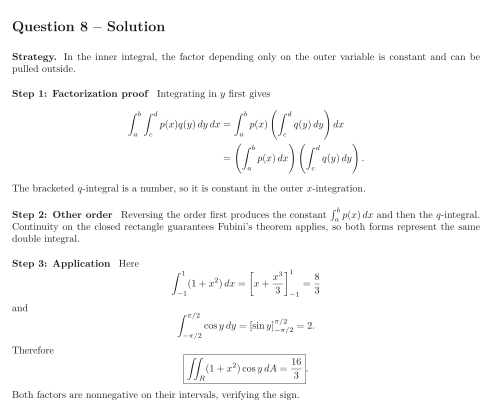
Original worksheet page 2: question and worked solution for 4-2-008

Original worksheet layout. Use Enlarge or open the PDF for a closer view.