Double Integrals over General Regions — Question 8

PDF ↗

Question 8

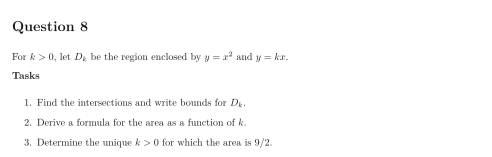
For k>0k>0, let DkD_k be the region enclosed by y=x2y=x^2 and y=kxy=kx.

Tasks

  1. Find the intersections and write bounds for DkD_k.

  2. Derive a formula for the area as a function of kk.

  3. Determine the unique k>0k>0 for which the area is 9/29/2.

Original worksheet page 1: question and worked solution for 4-3-008
Show solutionHide solution

Question 8 – Solution

Strategy. Keep the line slope symbolic; the nonzero intersection becomes the outer endpoint of a vertical-slice area integral.

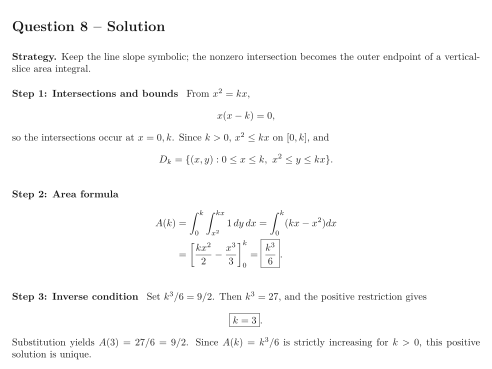
Step 1: Intersections and bounds From x2=kxx^2=kx, x(x−k)=0,x(x-k)=0, so the intersections occur at x=0,kx=0,k. Since k>0k>0, x2≤kxx^2\le kx on [0,k][0,k], and Dk={(x,y):0≤x≤k,x2≤y≤kx}.D_k=\{(x,y):0\le x\le k,\ x^2\le y\le kx\}.

Step 2: Area formula A(k)=∫0k∫x2kx1dydx=∫0k(kx−x2)dx=[kx22−x33]0k=k36.\begin{align*} A(k)&=\int_0^k\int_{x^2}^{kx}1\,dy\,dx =\int_0^k(kx-x^2)dx\\ &=\left[\frac{kx^2}{2}-\frac{x^3}{3}\right]_0^k =\boxed{\frac{k^3}{6}}. \end{align*}

Step 3: Inverse condition Set k3/6=9/2k^3/6=9/2. Then k3=27k^3=27, and the positive restriction gives k=3.\boxed{k=3}. Substitution yields A(3)=27/6=9/2A(3)=27/6=9/2. Since A(k)=k3/6A(k)=k^3/6 is strictly increasing for k>0k>0, this positive solution is unique.

Original worksheet page 2: question and worked solution for 4-3-008

Original worksheet layout. Use Enlarge or open the PDF for a closer view.