Triple Integrals in Spherical Coordinates — Question 3

PDF ↗

Question 3

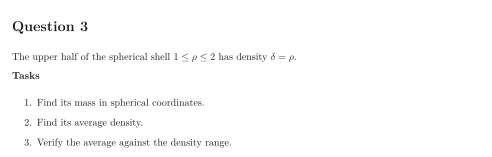
The upper half of the spherical shell 1≤ρ≤21\le\rho\le 2 has density δ=ρ\delta=\rho.

Tasks

  1. Find its mass in spherical coordinates.

  2. Find its average density.

  3. Verify the average against the density range.
Original worksheet page 1: question and worked solution for 4-7-003
Show solutionHide solution

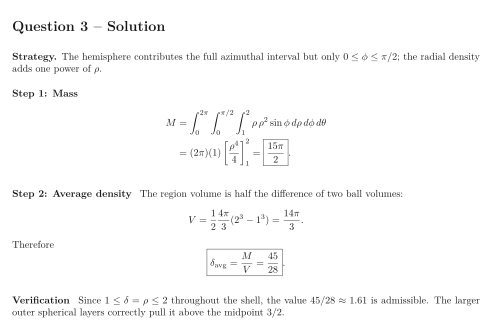
Question 3 – Solution

Strategy. The hemisphere contributes the full azimuthal interval but only 0≤ϕ≤π/20\le\phi\le\pi/2; the radial density adds one power of ρ\rho.

Step 1: Mass M=∫02π∫0π/2∫12ρρ2sin⁡ϕdρdϕdθ=(2π)(1)[ρ44]12=15π2.\begin{align*} M&=\int_0^{2\pi}\int_0^{\pi/2}\int_1^2 \rho\,\rho^2\sin\phi\,d\rho\,d\phi\,d\theta\\ &=(2\pi)(1)\left[\frac{\rho^4}{4}\right]_1^2 =\boxed{\frac{15\pi}{2}}. \end{align*}

Step 2: Average density The region volume is half the difference of two ball volumes: V=124π3(23−13)=14π3.V=\frac 12\frac{4\pi}{3}(2^3-1^3)=\frac{14\pi}{3}. Therefore δavg=MV=4528.\boxed{\delta_{\mathrm{avg}}=\frac{M}{V}=\frac{45}{28}}.

Verification Since 1≤δ=ρ≤21\le\delta=\rho\le 2 throughout the shell, the value 45/28≈1.6145/28\approx 1.61 is admissible. The larger outer spherical layers correctly pull it above the midpoint 3/23/2.

Original worksheet page 2: question and worked solution for 4-7-003

Original worksheet layout. Use Enlarge or open the PDF for a closer view.