Change of Variables — Question 4

PDF ↗

Question 4

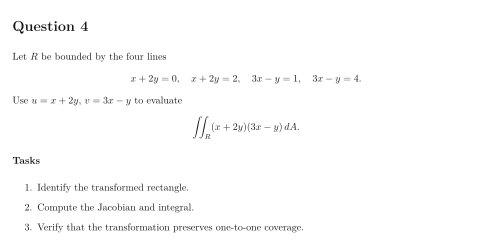
Let RR be bounded by the four lines x+2y=0,x+2y=2,3x−y=1,3x−y=4.x+2y=0,\quad x+2y=2,\quad 3x-y=1,\quad 3x-y=4. Use u=x+2yu=x+2y, v=3x−yv=3x-y to evaluate ∬R(x+2y)(3x−y)dA.\iint_R(x+2y)(3x-y)\,dA.

Tasks

  1. Identify the transformed rectangle.

  2. Compute the Jacobian and integral.

  3. Verify that the transformation preserves one-to-one coverage.
Original worksheet page 1: question and worked solution for 4-8-004
Show solutionHide solution

Question 4 – Solution

Strategy. Each pair of parallel boundary lines becomes a pair of constant-coordinate sides.

Step 1: Geometry

See the diagram in the original worksheet below.

The image is the rectangle 0≤u≤20\le u\le 2, 1≤v≤41\le v\le 4. The coefficient matrix has determinant ∂(u,v)∂(x,y)=∣123−1∣=−7.\frac{\partial(u,v)}{\partial(x,y)} =\begin{vmatrix}1&2\\3&-1\end{vmatrix}=-7. Since this determinant is nonzero, the linear map is globally one-to-one.

Step 2: Change variables We have dA=17dudvdA=\frac 17\,du\,dv and the integrand is uvuv. Hence I=17∫02∫14uvdvdu=17[u22]02[v22]14=157.\begin{align*} I&=\frac 17\int_0^2\int_1^4uv\,dv\,du\\ &=\frac 17\left[\frac{u^2}{2}\right]_0^2 \left[\frac{v^2}{2}\right]_1^4 =\boxed{\frac{15}{7}}. \end{align*}

Verification On the transformed rectangle, u≥0u\ge 0 and v>0v>0, so the positive answer has the required sign. The constant area scale 1/71/7 also matches the inverse determinant.

Original worksheet page 2: question and worked solution for 4-8-004

Original worksheet layout. Use Enlarge or open the PDF for a closer view.