Surface Area — Question 9

PDF ↗

Question 9

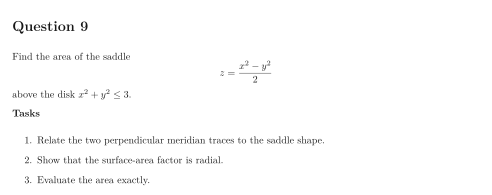
Find the area of the saddle z=x2−y22z=\frac{x^2-y^2}{2} above the disk x2+y2≤3x^2+y^2\le 3.

Tasks

  1. Relate the two perpendicular meridian traces to the saddle shape.

  2. Show that the surface-area factor is radial.

  3. Evaluate the area exactly.

Original worksheet page 1: question and worked solution for 4-9-009
Show solutionHide solution

Question 9 – Solution

Strategy. Although the height changes sign by direction, the squared gradient depends only on distance from the origin.

Step 1: Geometry

See the diagram in the original worksheet below.

Along y=0y=0 the trace opens upward, while along x=0x=0 it opens downward. Differentiation gives fx=x,fy=−y,1+fx2+fy2=1+r2.f_x=x,\qquad f_y=-y,\qquad \sqrt{1+f_x^2+f_y^2}=\sqrt{1+r^2}.

Step 2: Polar integral S=∫02π∫031+r2rdrdθ=2π[(1+r2)3/23]03=2π3(8−1)=14π3.\begin{align*} S&=\int_0^{2\pi}\int_0^{\sqrt 3}\sqrt{1+r^2}\,r\,dr\,d\theta\\ &=2\pi\left[\frac{(1+r^2)^{3/2}}{3}\right]_0^{\sqrt 3}\\ &=\frac{2\pi}{3}(8-1)=\boxed{\frac{14\pi}{3}}. \end{align*}

Verification The projected disk has area 3π3\pi, while the area factor ranges from 11 to 22. Hence 3π<S<6π3\pi<S<6\pi, and 14π/314\pi/3 lies in that interval.

Original worksheet page 2: question and worked solution for 4-9-009

Original worksheet layout. Use Enlarge or open the PDF for a closer view.