Vector Fields — Question 4

PDF ↗

Question 4

A three-dimensional gravitational field is modeled by 𝑮(x,y,z)=−12⟨x,y,z⟩(x2+y2+z2)3/2.\mathbf G(x,y,z)= -12\,\frac{\langle x,y,z\rangle}{(x^2+y^2+z^2)^{3/2}}.

Tasks

  1. Evaluate 𝑮\mathbf G at P=(2,−1,2)P=(2,-1,2).

  2. Find its magnitude and a unit vector in its direction.

  3. Explain the minus sign and state the field’s domain.
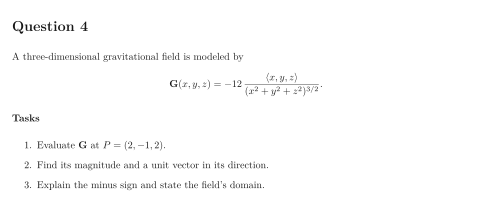
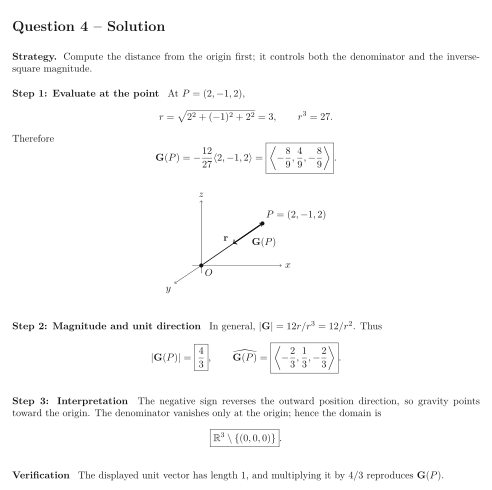
Original worksheet page 1: question and worked solution for 5-1-004
Show solutionHide solution

Question 4 – Solution

Strategy. Compute the distance from the origin first; it controls both the denominator and the inverse-square magnitude.

Step 1: Evaluate at the point At P=(2,−1,2)P=(2,-1,2), r=22+(−1)2+22=3,r3=27.r=\sqrt{2^2+(-1)^2+2^2}=3,\qquad r^3=27. Therefore 𝑮(P)=−1227⟨2,−1,2⟩=⟨−89,49,−89⟩.\mathbf G(P)=-\frac{12}{27}\langle 2,-1,2\rangle =\boxed{\left\langle-\frac 89,\frac 49,-\frac 89\right\rangle}.

See the diagram in the original worksheet below.

Step 2: Magnitude and unit direction In general, |𝑮|=12r/r3=12/r2|\mathbf G|=12r/r^3=12/r^2. Thus |𝑮(P)|=43,𝑮(P)̂=⟨−23,13,−23⟩.|\mathbf G(P)|=\boxed{\frac 43},\qquad \widehat{\mathbf G(P)} =\boxed{\left\langle-\frac 23,\frac 13,-\frac 23\right\rangle}.

Step 3: Interpretation The negative sign reverses the outward position direction, so gravity points toward the origin. The denominator vanishes only at the origin; hence the domain is ℝ3\{(0,0,0)}.\boxed{\mathbb R^3\setminus\{(0,0,0)\}}.

Verification The displayed unit vector has length 11, and multiplying it by 4/34/3 reproduces 𝑮(P)\mathbf G(P).

Original worksheet page 2: question and worked solution for 5-1-004

Original worksheet layout. Use Enlarge or open the PDF for a closer view.