Question 7
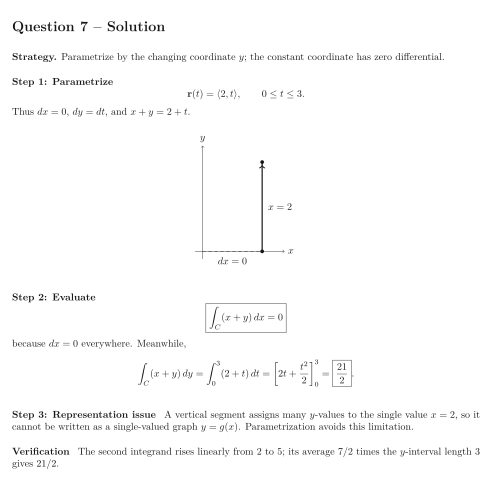
Let be the vertical segment from to . Evaluate both
Tasks
Parametrize the vertical segment.
Evaluate both integrals.
Explain why treating as a function of is inappropriate here.
Show solutionHide solution
Question 7 – Solution
Strategy. Parametrize by the changing coordinate ; the constant coordinate has zero differential.
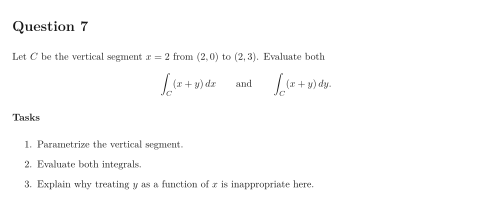
Step 1: Parametrize Thus , , and .
See the diagram in the original worksheet below.
Step 2: Evaluate because everywhere. Meanwhile,
Step 3: Representation issue A vertical segment assigns many -values to the single value , so it cannot be written as a single-valued graph . Parametrization avoids this limitation.
Verification The second integrand rises linearly from to ; its average times the -interval length gives .