Question 10
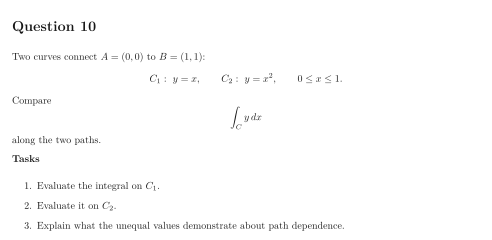
Two curves connect to : Compare along the two paths.
Tasks
Evaluate the integral on .
Evaluate it on .
Explain what the unequal values demonstrate about path dependence.
Show solutionHide solution
Question 10 – Solution
Strategy. Use the shared coordinate parameter on both paths, then compare the scalar functions traced between the same endpoints.
Step 1: Straight path On , , so
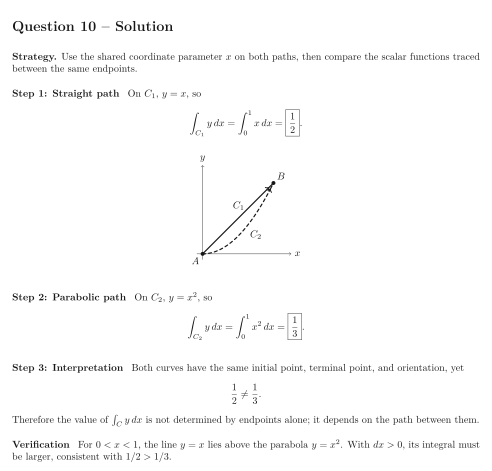
See the diagram in the original worksheet below.
Step 2: Parabolic path On , , so
Step 3: Interpretation Both curves have the same initial point, terminal point, and orientation, yet Therefore the value of is not determined by endpoints alone; it depends on the path between them.
Verification For , the line lies above the parabola . With , its integral must be larger, consistent with .