Line Integrals of Vector Fields — Question 2

PDF ↗

Question 2

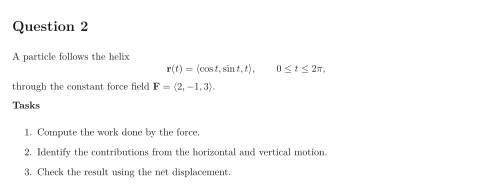
A particle follows the helix 𝒓(t)=⟨cos⁡t,sin⁡t,t⟩,0≤t≤2π,\mathbf r(t)=\langle\cos t,\sin t,t\rangle,\qquad 0\le t\le 2\pi, through the constant force field 𝑭=⟨2,−1,3⟩\mathbf F=\langle 2,-1,3\rangle.

Tasks

  1. Compute the work done by the force.

  2. Identify the contributions from the horizontal and vertical motion.

  3. Check the result using the net displacement.
Original worksheet page 1: question and worked solution for 5-4-002
Show solutionHide solution

Question 2 – Solution

Strategy. Dot the constant force with the velocity, then use the displacement as an independent check.

Step 1: Velocity and dot product 𝒓′(t)=⟨−sin⁡t,cos⁡t,1⟩,\mathbf r'(t)=\langle-\sin t,\cos t,1\rangle, so 𝑭⋅𝒓′(t)=−2sin⁡t−cos⁡t+3.\mathbf F\cdot\mathbf r'(t)=-2\sin t-\cos t+3.

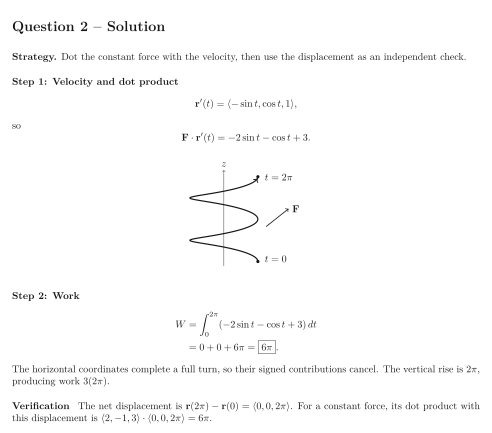
See the diagram in the original worksheet below.

Step 2: Work W=∫02π(−2sin⁡t−cos⁡t+3)dt=0+0+6π=6π.\begin{align*} W&=\int_0^{2\pi}(-2\sin t-\cos t+3)\,dt\\ &=0+0+6\pi=\boxed{6\pi}. \end{align*} The horizontal coordinates complete a full turn, so their signed contributions cancel. The vertical rise is 2π2\pi, producing work 3(2π)3(2\pi).

Verification The net displacement is 𝒓(2π)−𝒓(0)=⟨0,0,2π⟩\mathbf r(2\pi)-\mathbf r(0)=\langle 0,0,2\pi\rangle. For a constant force, its dot product with this displacement is ⟨2,−1,3⟩⋅⟨0,0,2π⟩=6π\langle 2,-1,3\rangle\cdot\langle 0,0,2\pi\rangle=6\pi.

Original worksheet page 2: question and worked solution for 5-4-002

Original worksheet layout. Use Enlarge or open the PDF for a closer view.