Line Integrals of Vector Fields — Question 10

PDF ↗

Question 10

On the counterclockwise circle C:x2+y2=9C:x^2+y^2=9, consider 𝑭(x,y)=⟨x−2y,2x+y⟩.\mathbf F(x,y)=\langle x-2y,\,2x+y\rangle. Compute ∮C𝑭⋅d𝒓\displaystyle\oint_C\mathbf F\cdot d\mathbf r by separating 𝑭\mathbf F into radial and tangential parts.

Tasks

  1. Decompose the field into radial and tangential vectors.

  2. Determine the work contributed by each part.

  3. Verify the answer by direct parametrization.
Original worksheet page 1: question and worked solution for 5-4-010
Show solutionHide solution

Question 10 – Solution

Strategy. Write the field as ⟨x,y⟩+2⟨−y,x⟩\langle x,y\rangle+2\langle-y,x\rangle; on a circle the first part is normal and the second is tangent.

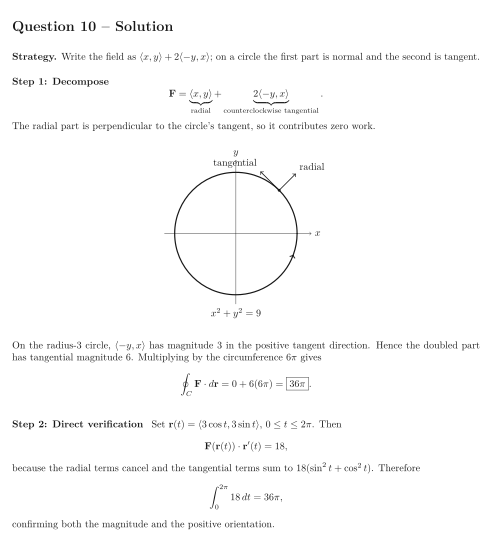
Step 1: Decompose 𝑭=⟨x,y⟩⏟radial+2⟨−y,x⟩⏟counterclockwise tangential.\mathbf F=\underbrace{\langle x,y\rangle}_{\text{radial}} +\underbrace{2\langle-y,x\rangle}_{\text{counterclockwise tangential}}. The radial part is perpendicular to the circle’s tangent, so it contributes zero work.

See the diagram in the original worksheet below.

On the radius-33 circle, ⟨−y,x⟩\langle-y,x\rangle has magnitude 33 in the positive tangent direction. Hence the doubled part has tangential magnitude 66. Multiplying by the circumference 6π6\pi gives ∮C𝑭⋅d𝒓=0+6(6π)=36π.\oint_C\mathbf F\cdot d\mathbf r=0+6(6\pi)=\boxed{36\pi}.

Step 2: Direct verification Set 𝒓(t)=⟨3cos⁡t,3sin⁡t⟩\mathbf r(t)=\langle 3\cos t,3\sin t\rangle, 0≤t≤2π0\le t\le 2\pi. Then 𝑭(𝒓(t))⋅𝒓′(t)=18,\mathbf F(\mathbf r(t))\cdot\mathbf r'(t)=18, because the radial terms cancel and the tangential terms sum to 18(sin⁡2t+cos⁡2t)18(\sin^2t+\cos^2t). Therefore ∫02π18dt=36π,\int_0^{2\pi}18\,dt=36\pi, confirming both the magnitude and the positive orientation.
Original worksheet page 2: question and worked solution for 5-4-010

Original worksheet layout. Use Enlarge or open the PDF for a closer view.