Fundamental Theorem for Line Integrals — Question 4

PDF ↗

Question 4

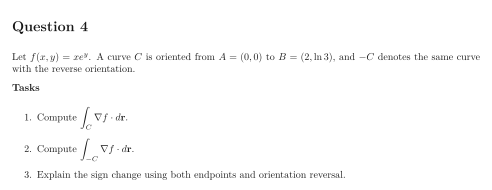
Let f(x,y)=xeyf(x,y)=xe^y. A curve CC is oriented from A=(0,0)A=(0,0) to B=(2,ln⁡3)B=(2,\ln 3), and −C-C denotes the same curve with the reverse orientation.

Tasks

  1. Compute ∫C∇f⋅d𝒓\displaystyle\int_C\nabla f\cdot d\mathbf r.

  2. Compute ∫−C∇f⋅d𝒓\displaystyle\int_{-C}\nabla f\cdot d\mathbf r.

  3. Explain the sign change using both endpoints and orientation reversal.
Original worksheet page 1: question and worked solution for 5-5-004
Show solutionHide solution

Question 4 – Solution

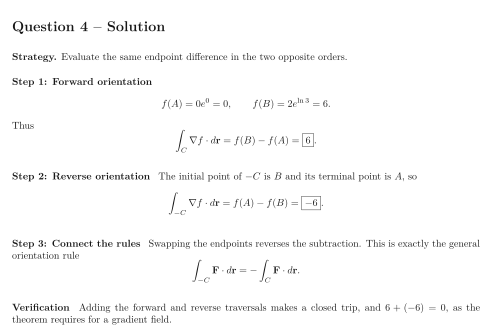
Strategy. Evaluate the same endpoint difference in the two opposite orders.

Step 1: Forward orientation f(A)=0e0=0,f(B)=2eln⁡3=6.f(A)=0e^0=0, \qquad f(B)=2e^{\ln 3}=6. Thus ∫C∇f⋅d𝒓=f(B)−f(A)=6.\int_C\nabla f\cdot d\mathbf r=f(B)-f(A)=\boxed{6}.

Step 2: Reverse orientation The initial point of −C-C is BB and its terminal point is AA, so ∫−C∇f⋅d𝒓=f(A)−f(B)=−6.\int_{-C}\nabla f\cdot d\mathbf r=f(A)-f(B)=\boxed{-6}.

Step 3: Connect the rules Swapping the endpoints reverses the subtraction. This is exactly the general orientation rule ∫−C𝑭⋅d𝒓=−∫C𝑭⋅d𝒓.\int_{-C}\mathbf F\cdot d\mathbf r=-\int_C\mathbf F\cdot d\mathbf r.

Verification Adding the forward and reverse traversals makes a closed trip, and 6+(−6)=06+(-6)=0, as the theorem requires for a gradient field.
Original worksheet page 2: question and worked solution for 5-5-004

Original worksheet layout. Use Enlarge or open the PDF for a closer view.