Question 2
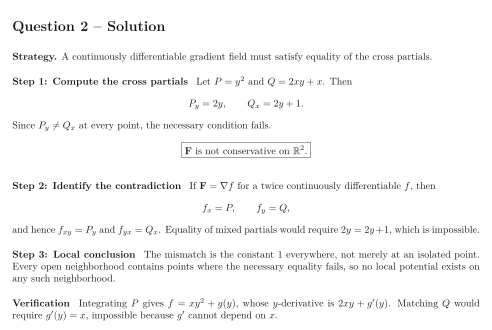
Consider on .
Tasks
Test whether is conservative.
Identify the exact obstruction.
Explain why no potential function can exist even locally near any point.
Show solutionHide solution
Question 2 – Solution
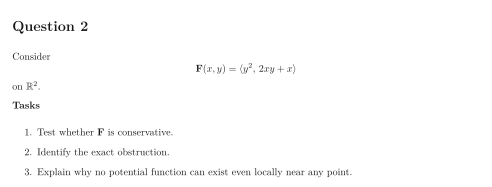
Strategy. A continuously differentiable gradient field must satisfy equality of the cross partials.
Step 1: Compute the cross partials Let and . Then Since at every point, the necessary condition fails.
Step 2: Identify the contradiction If for a twice continuously differentiable , then and hence and . Equality of mixed partials would require , which is impossible.
Step 3: Local conclusion The mismatch is the constant everywhere, not merely at an isolated point. Every open neighborhood contains points where the necessary equality fails, so no local potential exists on any such neighborhood.
Verification Integrating gives , whose -derivative is . Matching would require , impossible because cannot depend on .