Conservative Vector Fields — Question 6

PDF ↗

Question 6

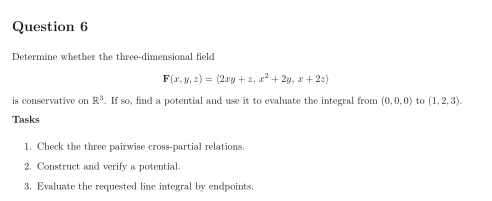
Determine whether the three-dimensional field 𝑭(x,y,z)=⟨2xy+z,x2+2y,x+2z⟩\mathbf F(x,y,z)=\langle 2xy+z,\,x^2+2y,\,x+2z\rangle is conservative on ℝ3\mathbb R^3. If so, find a potential and use it to evaluate the integral from (0,0,0)(0,0,0) to (1,2,3)(1,2,3).

Tasks

  1. Check the three pairwise cross-partial relations.

  2. Construct and verify a potential.

  3. Evaluate the requested line integral by endpoints.
Original worksheet page 1: question and worked solution for 5-6-006
Show solutionHide solution

Question 6 – Solution

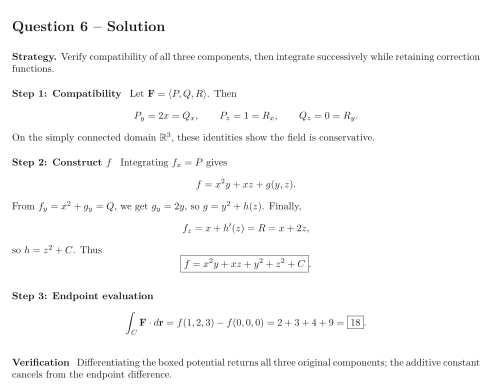
Strategy. Verify compatibility of all three components, then integrate successively while retaining correction functions.

Step 1: Compatibility Let 𝑭=⟨P,Q,R⟩\mathbf F=\langle P,Q,R\rangle. Then Py=2x=Qx,Pz=1=Rx,Qz=0=Ry.P_y=2x=Q_x, \qquad P_z=1=R_x, \qquad Q_z=0=R_y. On the simply connected domain ℝ3\mathbb R^3, these identities show the field is conservative.

Step 2: Construct ff Integrating fx=Pf_x=P gives f=x2y+xz+g(y,z).f=x^2y+xz+g(y,z). From fy=x2+gy=Qf_y=x^2+g_y=Q, we get gy=2yg_y=2y, so g=y2+h(z)g=y^2+h(z). Finally, fz=x+h′(z)=R=x+2z,f_z=x+h'(z)=R=x+2z, so h=z2+Ch=z^2+C. Thus f=x2y+xz+y2+z2+C.\boxed{f=x^2y+xz+y^2+z^2+C}.

Step 3: Endpoint evaluation ∫C𝑭⋅d𝒓=f(1,2,3)−f(0,0,0)=2+3+4+9=18.\int_C\mathbf F\cdot d\mathbf r=f(1,2,3)-f(0,0,0) =2+3+4+9=\boxed{18}.

Verification Differentiating the boxed potential returns all three original components; the additive constant cancels from the endpoint difference.
Original worksheet page 2: question and worked solution for 5-6-006

Original worksheet layout. Use Enlarge or open the PDF for a closer view.