Conservative Vector Fields — Question 9

PDF ↗

Question 9

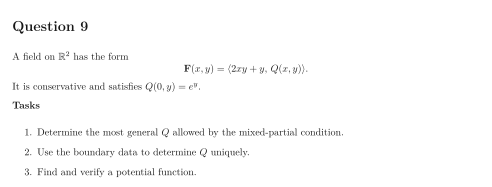
A field on ℝ2\mathbb R^2 has the form 𝑭(x,y)=⟨2xy+y,Q(x,y)⟩.\mathbf F(x,y)=\langle 2xy+y,\,Q(x,y)\rangle. It is conservative and satisfies Q(0,y)=eyQ(0,y)=e^y.

Tasks

  1. Determine the most general QQ allowed by the mixed-partial condition.

  2. Use the boundary data to determine QQ uniquely.

  3. Find and verify a potential function.
Original worksheet page 1: question and worked solution for 5-6-009
Show solutionHide solution

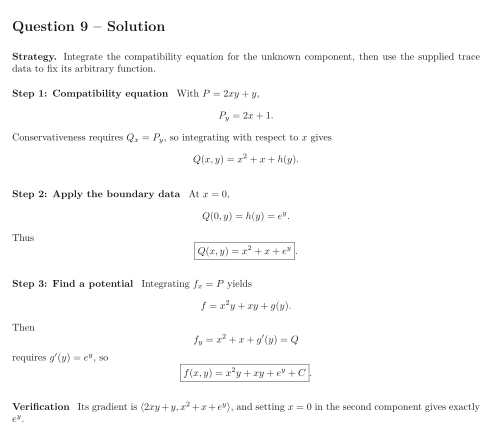
Question 9 – Solution

Strategy. Integrate the compatibility equation for the unknown component, then use the supplied trace data to fix its arbitrary function.

Step 1: Compatibility equation With P=2xy+yP=2xy+y, Py=2x+1.P_y=2x+1. Conservativeness requires Qx=PyQ_x=P_y, so integrating with respect to xx gives Q(x,y)=x2+x+h(y).Q(x,y)=x^2+x+h(y).

Step 2: Apply the boundary data At x=0x=0, Q(0,y)=h(y)=ey.Q(0,y)=h(y)=e^y. Thus Q(x,y)=x2+x+ey.\boxed{Q(x,y)=x^2+x+e^y}.

Step 3: Find a potential Integrating fx=Pf_x=P yields f=x2y+xy+g(y).f=x^2y+xy+g(y). Then fy=x2+x+g′(y)=Qf_y=x^2+x+g'(y)=Q requires g′(y)=eyg'(y)=e^y, so f(x,y)=x2y+xy+ey+C.\boxed{f(x,y)=x^2y+xy+e^y+C}.

Verification Its gradient is ⟨2xy+y,x2+x+ey⟩\langle 2xy+y,x^2+x+e^y\rangle, and setting x=0x=0 in the second component gives exactly eye^y.

Original worksheet page 2: question and worked solution for 5-6-009

Original worksheet layout. Use Enlarge or open the PDF for a closer view.