Green's Theorem — Question 3

PDF ↗

Question 3

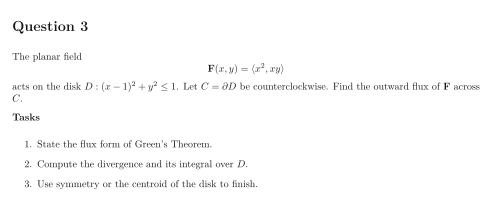
The planar field 𝑭(x,y)=⟨x2,xy⟩\mathbf F(x,y)=\langle x^2,xy\rangle acts on the disk D:(x−1)2+y2≤1D:(x-1)^2+y^2\le 1. Let C=∂DC=\partial D be counterclockwise. Find the outward flux of 𝑭\mathbf F across CC.

Tasks

  1. State the flux form of Green’s Theorem.

  2. Compute the divergence and its integral over DD.

  3. Use symmetry or the centroid of the disk to finish.
Original worksheet page 1: question and worked solution for 5-7-003
Show solutionHide solution

Question 3 – Solution

Strategy. Convert outward flux to the double integral of the planar divergence.

Step 1: Flux form For 𝑭=⟨M,N⟩\mathbf F=\langle M,N\rangle, ∮C𝑭⋅𝒏ds=∮CMdy−Ndx=∬D(Mx+Ny)dA.\oint_C\mathbf F\cdot\mathbf n\,ds =\oint_C M\,dy-N\,dx =\iint_D(M_x+N_y)\,dA. Here Mx+Ny=2x+x=3x.M_x+N_y=2x+x=3x.

See the diagram in the original worksheet below.

Step 2: Integrate The disk has area π\pi and centroid (1,0)(1,0). Therefore its average xx-coordinate is 11, so ∬DxdA=1⋅π=π.\iint_Dx\,dA=1\cdot\pi=\pi. Consequently, ∮C𝑭⋅𝒏ds=∬D3xdA=3π.\boxed{\oint_C\mathbf F\cdot\mathbf n\,ds =\iint_D3x\,dA=3\pi}.

Verification The disk lies in 0≤x≤20\le x\le 2, so the divergence 3x3x is nonnegative. A positive outward flux is therefore consistent with the sign of the integrand.

Original worksheet page 2: question and worked solution for 5-7-003

Original worksheet layout. Use Enlarge or open the PDF for a closer view.