Question 3
Let At , determine the local expansion rate and the curl vector.
Tasks
Compute and evaluate the divergence.
Compute and evaluate the curl.
Interpret the curl’s axis, direction, and infinitesimal angular-speed relation.
Show solutionHide solution
Question 3 – Solution
Strategy. Use divergence for local volume change and curl for twice the infinitesimal angular-velocity vector.
Step 1: Expansion rate At , this is so the field has positive local expansion there.
Step 2: Curl This curl is constant, so its value at is the same vector.
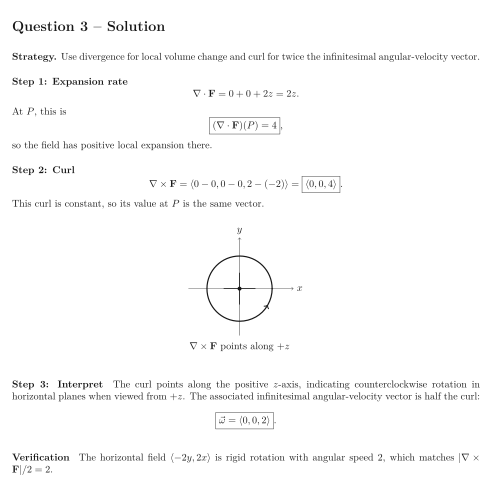
See the diagram in the original worksheet below.
Step 3: Interpret The curl points along the positive -axis, indicating counterclockwise rotation in horizontal planes when viewed from . The associated infinitesimal angular-velocity vector is half the curl:
Verification The horizontal field is rigid rotation with angular speed , which matches .