Curl and Divergence β€” Question 5

PDF β†—

Question 5

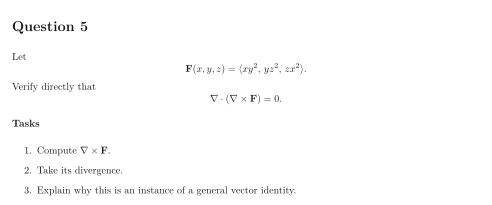
Let 𝑭(x,y,z)=⟨xy2,yz2,zx2⟩.\mathbf F(x,y,z)=\langle xy^2,\,yz^2,\,zx^2\rangle. Verify directly that βˆ‡β‹…(βˆ‡Γ—π‘­)=0.\nabla\cdot(\nabla\times\mathbf F)=0.

Tasks

  1. Compute βˆ‡Γ—π‘­\nabla\times\mathbf F.

  2. Take its divergence.

  3. Explain why this is an instance of a general vector identity.
Original worksheet page 1: question and worked solution for 6-1-005
Show solutionHide solution

Question 5 – Solution

Strategy. Compute the curl componentwise, then differentiate each component with respect to its matching coordinate.

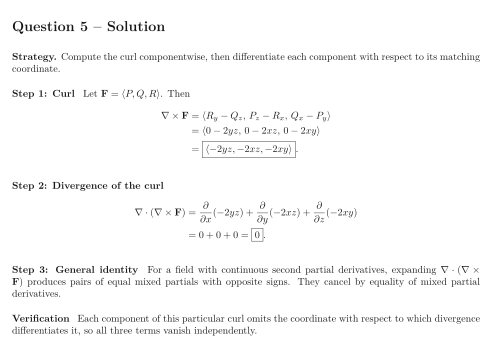
Step 1: Curl Let 𝑭=⟨P,Q,R⟩\mathbf F=\langle P,Q,R\rangle. Then βˆ‡Γ—π‘­=⟨Ryβˆ’Qz,Pzβˆ’Rx,Qxβˆ’Py⟩=⟨0βˆ’2yz,0βˆ’2xz,0βˆ’2xy⟩=βŸ¨βˆ’2yz,βˆ’2xz,βˆ’2xy⟩.\begin{align*} \nabla\times\mathbf F &=\langle R_y-Q_z,\,P_z-R_x,\,Q_x-P_y\rangle\\ &=\langle 0-2yz,\,0-2xz,\,0-2xy\rangle\\ &=\boxed{\langle-2yz,-2xz,-2xy\rangle}. \end{align*}

Step 2: Divergence of the curl βˆ‡β‹…(βˆ‡Γ—π‘­)=βˆ‚βˆ‚x(βˆ’2yz)+βˆ‚βˆ‚y(βˆ’2xz)+βˆ‚βˆ‚z(βˆ’2xy)=0+0+0=0.\begin{align*} \nabla\cdot(\nabla\times\mathbf F) &=\frac{\partial}{\partial x}(-2yz) +\frac{\partial}{\partial y}(-2xz) +\frac{\partial}{\partial z}(-2xy)\\ &=0+0+0=\boxed{0}. \end{align*}

Step 3: General identity For a field with continuous second partial derivatives, expanding βˆ‡β‹…(βˆ‡Γ—π‘­)\nabla\cdot(\nabla\times\mathbf F) produces pairs of equal mixed partials with opposite signs. They cancel by equality of mixed partial derivatives.

Verification Each component of this particular curl omits the coordinate with respect to which divergence differentiates it, so all three terms vanish independently.
Original worksheet page 2: question and worked solution for 6-1-005

Original worksheet layout. Use Enlarge or open the PDF for a closer view.